
There’s an old saying that insurance doesn’t matter…until it does. General liability, GL for short, is fundamental to the business world. Most everyone knows that GL protects you from suits and claims brought against you by people injured on your jobsite, or homeowners who allege damage caused by defects in the way a house was built. Beyond this, things get a little fuzzy, which leads to some creative myth-making. Here are the top 5 GL myths we hear all the time:
Counting Down the Myths
#5 - I have Builders Risk. I don’t need GL, do I?
Builders risk only covers your building materials at your jobsites while during construction. It’s property coverage. With limited exceptions on some policies, there is no coverage for a passerby who trips and falls over a piece of scrap lumber that spilled onto the sidewalk and no coverage for construction defect claims later on.
#4 - My subs have GL, so I don’t need it, or do I? 

Your subcontractors better have GL, or their claims become yours. Even if they have their own coverage, you can still be liable for some claims involving your subs. As the general contractor, you’re responsible for overall safety at the jobsite. Are you making sure your subs keep the sidewalks free of scrap lumber and other debris? Even if you police the jobsite every day, when was the last time you required your subs to provide a certificate of insurance? Are you named additional insured on their GL policies? Do they hold you harmless in your written contracts with them? All these things can create liability for you if neglected.
#3 - I do some engineering and design work on the side. My GL covers that, right?
Wrong. If you provide any professional services, you need professional liability insurance. GL doesn’t cover inaccurate advice, misrepresentation or claims involving bad faith.
#2 - I only build one home a year. I’m too small to need GL, aren’t I?
I’ll answer this question with a question – the last time you drove down any highway, how many billboards advertising personal injury law firms did you see? We live in a highly litigious society. Any business, no matter how small, how new, or how experienced is vulnerable to suits or claims by members of the public. Why take chances with your livelihood?
AND THE #1 GL MYTH – I’ve been in business for 20 years and never had a claim. Why should I pay for GL now?
I could answer this by simply saying read #2 again. The fact is you don’t have to purchase GL unless someone else requires it. Usually, some other business or governmental entity wants to see proof that you have GL. Why? To avoid having to deal with suits or claims that you’re responsible for. It’s called contingent liability. In reason #4, if you hire a sub who doesn’t have GL, you are responsible for his claims while working for you because you failed to make sure he had the necessary insurance. Not fair you say? Show me fair.
I hope this little countdown of GL myths helps to convince the previously unconvinced that having the proper GL coverage for your business is just as important as laying the proper foundation for a home. Anything you build on top of a shaky foundation is bound to fall sometime. For the riverboat gamblers out there nothing I say will be convincing. For the great majority of you, it might be time to take a look at your GL coverage needs. We can also handle your builders’ risk while we're at it. 
Call us at 1-866-454-2156 or visit us at https://rwcinsuranceadvantage.com/products/general-liability/ for a free, no obligation quote.
According to an analysis by PeopleReady.com's skilled trades division, there were 388,345 jobs posted for trades-related workers between May and June of this year.
Positions most in demand are:
- Concrete Masons
- Window Glaziers
- House Painters
- Electricians
- Plumbers
- Carpenters
NAHB Members and HBAs are trying to do their part and actively recruit the next generation, however, finding qualified subs and trades continues to be a challenge for the residential construction industry. Nonetheless, they are stepping up to the plate and taking action. By providing supplies, scholarships, and one-on-one connections with students, HBAs around the country are getting out into their communities to spread the word about the rewarding jobs throughout the industry through:
- Lectures at Community Colleges - Supplies and Scholarship Support through High Schools and Local Technical Schools - Direct Connections to Career Professionals through Events and Home Shows
NAHB.org's Careers in Construction toolkit has ideas and resources for members and HBAs to connect with their local community. Check it out!
Source nahb.org
Stay up-to-date with the Warranty Company, Upcoming Events, & Industry News.
[vc_row][vc_column][vc_column_text]
 Ronald L. Sweigert was recently named co-manager of RWC's Member Services Department in charge of enrollments and customer service. In his nearly twenty-nine years of service with our company, Ron has worked as a warranty advisor, as a special agent for insurance sales, and as general manager of a small builder call-back service operation. Most recently he was a warranty administrator in our Member Services Department. We are confident that Ron’s long and varied experience together with his penchant for innovation will serve him and the company well in his new position. Ron replaces Sandra Sweigert, who agreed to take on more responsibility for the company as co-manager in our Warranty Resolution Department.
Logan M. Radle also has been named co-manager of the Member Services Department in charge of underwriting. Logan is a 2011 graduate of Millersville University and is licensed in property and casualty insurance by the Pennsylvania Insurance Department. Prior to joining us, Logan worked as a claim specialist for a national insurance company. Since coming on board, she has distinguished herself in our insurance operations, where she oversaw the underwriting of bonds for members of the warranty programs. Logan’s training, demeanor, and attention to detail make her an ideal fit for her new position. Logan replaces long-time manager Bryon Earhart, who has reduced his workweek to two days so that he can tend to familial obligations. Bryon will continue with the company on a part-time basis as our Chief Warranty Underwriter.
[/vc_column_text][/vc_column][/vc_row]
As a Member in our warranty program, you are probably familiar with our Warranty Express online enrollment system. You enroll the home online and, after closing occurs and payment/forms are sent to us for processing, your buyers are able to download their warranty documents from our website.
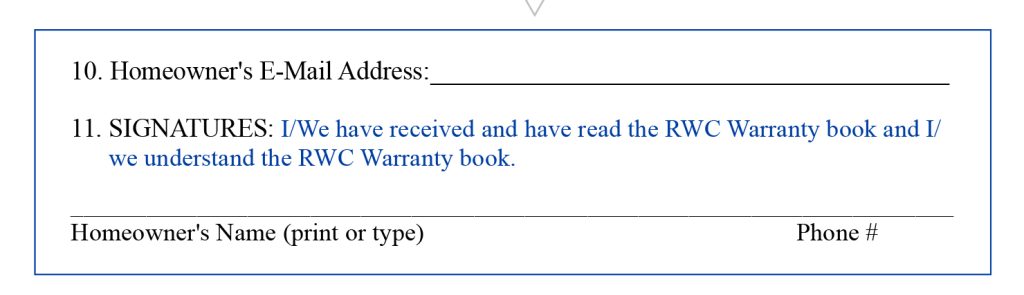
We use 60 days as the time frame after closing before documents are posted but often, those documents are available much sooner. Did you know if you provide your buyers' email address on the Application for Warranty form (#10 on the form - see example below), we will send them an email to notify them whenever their warranty documents are ready to download?
We know that everyone gets bombarded with emails and sometimes “system-generated” notices can look like spam. Let your buyers know that they will get the following notice from us.
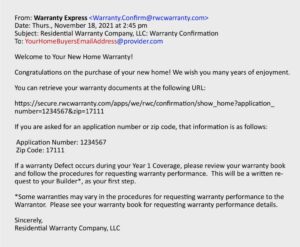
Then that’s it. We don’t spam them or communicate with them further unless they reach out to us for assistance.
Once they have the email, they simply click the link provided to go directly to the login page so they can easily download their warranty book and warranty confirmation form. It’s simple and convenient.
But if they are suspicious or even just accidentally delete the email, no worries. They can call or email our Member Services Department for assistance. And even if they NEVER download these documents, as long as we have received the warranty form and payment after closing, their home is covered for the entire warranty term. Those documents will stay online for the duration of their warranty.
Warranty Express is chock full of features for you. In addition to enrolling homes, you can:
- Print / reprint warranty documents for closing,
- Pay warranty fees online – and save on shipping and handling charges,
- Generate enrollment reports,
- See your entire order history,
- Order FREE marketing materials,
- Upload documents securely and directly to us,
- And even add affiliated memberships.
Have questions on this feature or on any feature in Warranty Express? Call us at 800-247-1812 and ask for the Member Services Department. We are happy to help!
 We recently had the good fortune to hear an inspirational sermon on minding our tongues. The principal idea was that we should watch what we say and guard against hurting ourselves and others by engaging in harmful gossip, mindless vulgarity, and unwarranted vitriol. The message was that not only does this kind of speech hurt others, but it also damages the speaker in various ways. The lesson was a good one that would no doubt benefit many people. Personally, I took a few notes and even posted part of the lesson next to the computer where I receive and send emails.
The subject of that sticky note concerns a test one can employ to determine whether he should speak on a subject or listen to someone else do so. The “triple filter test” is often credited to Socrates and is usually told as a dialogue between him and one of his students. As the tale goes, an acquaintance of Socrates’ said something unflattering about Socrates to the student. The next time he saw Socrates, the student was anxious to let Socrates know what was being said about him. But Socrates stopped his student and told him he should not share what was said unless it could pass through any of three different filters.
Socrates asked if the student knew the statement to be true. The student said that he did not know, and Socrates replied, “If you do not know it to be true, why would you say it, and why should I hear it?”
He then asked if the statement was good or kind. The student answered that it was not, to which Socrates replied, “If this statement is not true and is neither good, nor kind, why would you say it, and why should I hear it?”
Finally, Socrates asked whether the statement was necessary for him to hear or whether hearing it would be useful to him. The disappointed student said it was not. Socrates asked the student, “If this statement is not true, good, kind, necessary or useful, why would you say it, and why should I hear it?” The student held his tongue and learned a valuable lesson, a lesson that remains instructive today.
The story of Socrates’ three filters resonates now because, while wisdom suggests and sermons implore us to live one way, many people still find it difficult or impossible to do so. Consequently, as they have through the ages, people will talk, and they do not always care whether what they say is true, good, kind, necessary or useful. A strong individual, like Socrates, can stay above the fray and choose to ignore and not engage in banter that cannot pass through any of the three filters. That is not as easy, or as desirable, for a business to do. Unfair public comments about any company can have a negative effect on its bottom line, on the morale of its people, and even on its ability to stay in business.
The good news is that you and your company are not merely at the mercy of those wagging tongues. There are measures builders can take to protect their company’s reputation from everything from second-hand unflattering comments to scurrilous attacks on the quality of their work and the character of their people, and everything in between.
Here are just a few such techniques that can help protect a builder’s reputation in the marketplace.
Monitor your online presence and reviews. Even if you have not set up a business profile online, people can leave comments and reviews about your company on various websites. Search your company’s name on the internet and see where people are talking about you and what they are saying. If possible, address any unfair criticism and consider giving your side of the story regarding any fair complaint. If you discover a major problem, consider retaining an online reputation consulting firm or reputation management software.
Be a positive force in the communities where you build and keep an ear to the ground. Encourage your management team and your staff to engage in public service in the communities where you build. Not only will this enhance your company’s image, but your employees will get satisfaction from helping others, and they will be able to hear any negative scuttlebutt about your company that might be circulating in the community.

Treat your employees fairly. One source for negative comments about businesses is the disgruntled employee. He knows a lot about how his employer operates, he knows what to say that will hurt his employer in the marketplace, and he has an ax to grind. Do your best to keep your employees happy and supported. If an employee is heading down a negative road, try to reel him back in so that he can continue working as part of your team. If saving him is unlikely, consider parting ways earlier rather than later and on terms that do not further antagonize him.
Do good work and keep your customers happy. There is no better advertisement than the earnest praise of a satisfied customer. Deliver what you promised, service your product, and be prompt and courteous whenever dealing with a purchaser of one of your homes, and it is unlikely your customers will be making comments that damage your reputation. Consider using satisfied customers’ comments to get a positive buzz going or to counter any negative impression that already exists about your company.
Associate with the best third-party services providers in the business who know how to treat your customers right. Anyone you recommend to your purchasers or with whom you partner in assisting your purchasers is viewed as an extension of you by your customer. Make sure the real estate agents, subcontractors, landscapers, insurance agents, and warranty companies with whom you associate understand your mission and respect your customers as much as you do. By doing so, you will enhance your reputation with your customers and in the community.
RWC can help you enhance that reputation by providing your customers and you with the best new home warranty on the market. We have been in the home warranty business for over four decades and have issued and administered warranties on more than 3.7 million homes! We offer a wide variety of warranty options, from the standard ten-year warranty to our Day 1 coverage warranty, from our extended appliance and system warranties to our specialty warranties for remodeling projects, detached garages, and commercial construction. Only RWC has developed and offers its members a customized state warranty that mirrors each state’s statute of repose and accommodates other state-specific issues. All RWC warranties provide clear performance standards that help create realistic expectations in your homeowners and provide a road map to resolving even the stickiest customer complaints.
At RWC, every guarantee our warranties make is backed by Western Pacific Mutual Insurance Company, RRG. Western Pacific has an "A- (Excellent)" rating from A.M. Best and only insures home warranty and similar new home construction risks, like builders’ general liability, that can be offered through the RWC Insurance Advantage program to RWC members. No other warranty company can boast an insurer with this kind of strength that is solely dedicated to covering builders and warranting the performance of their homes. Our pleasant customer service staff is dedicated to making your interactions with RWC as smooth as possible, and our veteran warranty resolution team will handle your customers’ claims with care.
People will talk, but why not get them talking about what a great builder you are? Put your best foot forward by giving your customers the best warranty around, an RWC warranty!
Have a great Fall and Winter!
From the beginning of the Coronavirus pandemic through the current move back toward a more normalized way of life, there have been product shortages due to sudden high demand and proportionately low supply. Toilet paper…under the circumstances, was a bit of a surprise. Meat and poultry…certainly understandable. But in an unexpected twist is lumber.
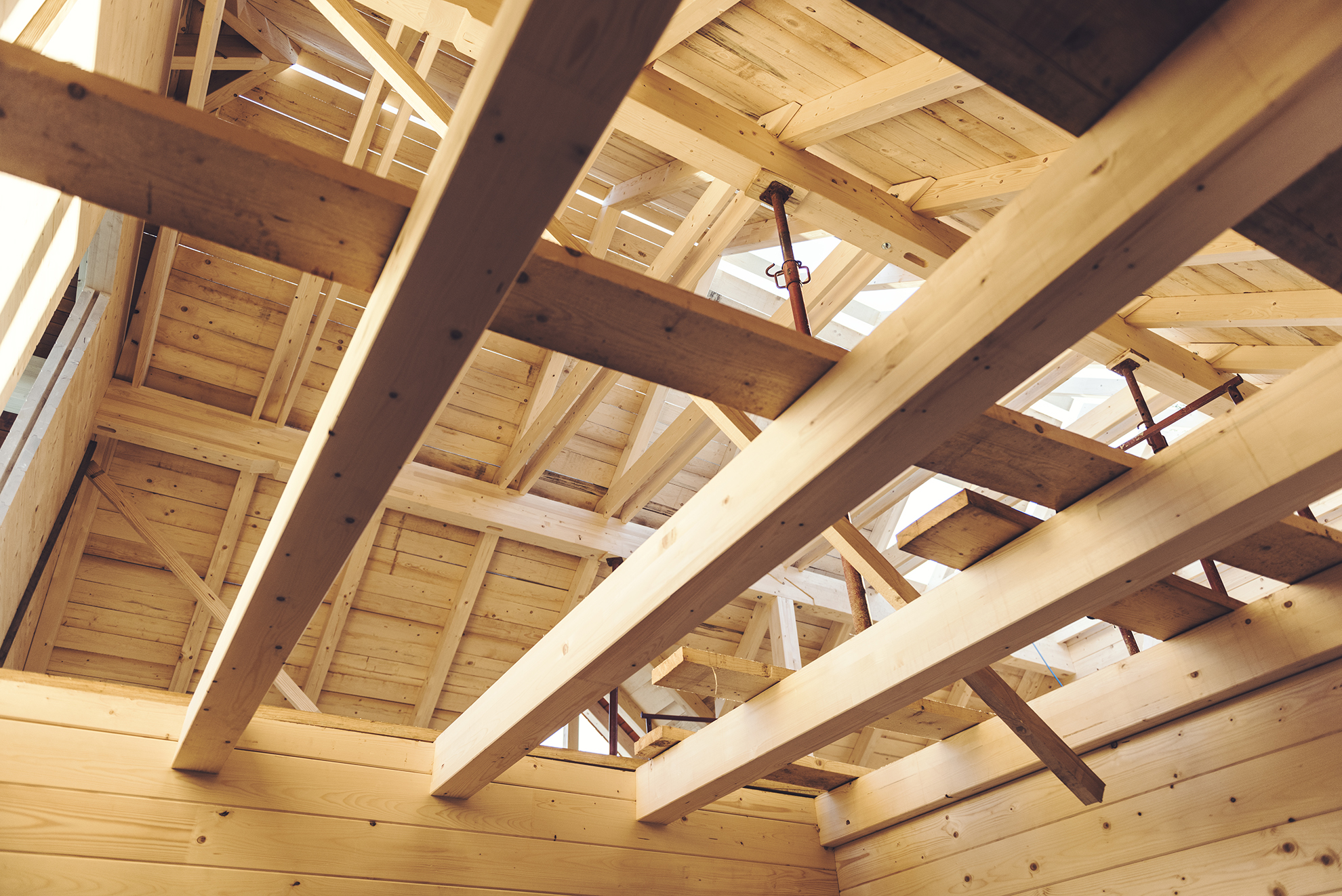
While there was a drop in lumber costs at the onset of the pandemic, that is unfortunately no longer the case. The initial slump was a product of the global lockdown in response to the outbreak. Construction operations in many locations were shut down, and lumber mills and other processing facilities were left with an excess supply of material.
However, due to the subsequent fragility of the economy was the appearance of some of the lowest interest rates in recent history. Low interest rates for both home mortgages and new construction financing coupled with a desire for people to move forward with their lives in a productive manner led to a boom in the building and remodeling industries once businesses began reopening in June of 2020. This, in turn, had a severe impact on the lumber industry. Mills and other processing facilities went from having too much wood to a shortfall virtually overnight. The supply of lumber has also been strained by insufficient domestic production due in part to the 2020 wildfires and limited international access due to hefty tariffs on Canadian softwood.
Because the housing market is on fire, the lumber shortage is costing many prospective home buyers even more money. The National Association of Realtors (NAR) reported in February that rising lumber costs added $24,000 to the cost of new homes since the start of the pandemic. As of April, that number had increased to nearly $36,000. Home prices have been on the rise for years, but they reached a peak during the pandemic. In April, the median home sales price rose to an all-time high of $375,000, according to Realtor.com. Some renters are also feeling the impact. The National Association of Home Builders (NAHB) estimates that the lumber price spike has added nearly $13,000 to the market value of an average newly built multifamily home — translating to households paying nearly $125 more per month to rent a new apartment.
Homebuyers are not the only ones to feel the impact. The shortage — and price boom — is so extreme that builders have reported having lumber and other raw materials stolen from their construction sites. And in a more far-reaching scenario, some financial advisors have expressed concerns that a lumber crash could lead to a stock market crash. Without an immediate solution to the lumber crisis, affordability will remain out of reach for many prospective home buyers as supply remains scarce. The good news is that industry executives expect lumber production to catch up with demand - eventually. Some say it can feasibly occur over the span of the next 18 months. As for now, the “new normal” cost for lumber is around $800 per 1,000 board feet.
NAHB continues to seek action from the Biden administration and other lawmakers by encouraging domestic lumber producers to increase production to ease growing shortages, as well as collaborating with Canada on a new softwood lumber agreement.
Unpredictable summer weather can stir up additional concerns amid already challenging times. The warmer weather may bring devastating hurricanes and other natural disasters.
The 2020 hurricane season was very active. By the time all was said and done, the Atlantic Basin experienced 30 named storms. The National Hurricane Center actually exhausted the standard alphabetical list and moved onto the greek alphabet for naming conventions. We can only hope that 2021 does not follow that trend.
Nasty weather causes ripples in many ways of life, including the building industry. Resources are already stretched thin due to supply chain issues and material shortages. If you haven’t done so already, now is the time to start preparing for upcoming potential threats.
The National Association of Home Builders (NAHB) recommends businesses have a solid plan in place that covers everything from suppliers to staffing and even bracing for worsening economic impact.

The NAHB sheds light on several things to consider when planning your operations during natural disaster season.
For the housing industry, some examples of COVID-19-related impacts that should be taken into consideration during business continuity and preparedness planning this hurricane season include:
Personal Protective Equipment (PPE) supply chains: Plan to communicate frequently with any current PPE suppliers to gauge the availability of masks or anything else imperative to your business.
Workforce disruptions: A major storm or natural disaster could have a major impact on local labor at a time when COVID-19 has already heavily influenced many companies staffing levels.
Supply chain and material availability and scheduling: Many suppliers have seen extended backorders for certain building materials and adjusted delivery procedures according to social distancing measures and this may be further affected by a severe weather event.

Non-congregate sheltering options for employees and their families: Should an evacuation be ordered, or external sheltering be needed for a hurricane or tornado, plan for contingencies that allow for adherence to local social distancing requirements.
Communication and virtual infrastructure: As with any major weather event, local electric and telecommunications infrastructure can sustain damage resulting in outages. These outages could be extremely detrimental to operations during the pandemic as many companies are already conducting most business virtually or over the phone. Be sure to have robust communication plans that include multiple pre-established contact channels for employees and virtual infrastructure backups to support any virtual construction-related technologies that were adopted as a result of the pandemic.
Economic impacts: The effects of the global pandemic have heavily impacted many companies’ financials. During business continuity and preparedness planning, account for how a major business disruption caused by a natural disaster could impact any COVID-19-related loans or federal aid.
Limiting personal exposure when evacuating and restarting operations: From securing the worksite or office, to evacuations, and eventual return to normal operations, planning for appropriate social distancing and safety measures will be important to plan for this upcoming season.
Ever REALLY wonder why you buy insurance? Many states require you to carry General Liability to maintain a license. Other entities require proof of insurance before you begin any project. The list of those requiring proof of “liability” insurance is long. If you think about it, all that money just to satisfy these demands is frustrating. On top of that, there are builders who have been in business for decades who have never had a “third party” claim. So, what is the real value of General Liability insurance?

Think of it as insurance against “WHAT IFS.” What if a prospect for a home visits your office and trips and falls over a loose rug, fracturing her wrist? What if a subcontractor fails to install flashing around some windows and the homeowner sues you for the resulting water damage years later? What if the person you hired to manage your website posts damaging information about your main competitor and you’re sued for libel? What if a guest at your BYOB holiday party has too much to drink and causes a serious accident on the way home?
If you’re thinking the list of “what ifs” could go on indefinitely, you’re beginning to see just how “general” general liability can be. At the risk of over-simplifying, when it comes to general liability insurance, unless it’s excluded, it’s covered.*
Most people think “sure those things can and do happen, but what are the odds they’ll happen to me?” That’s a reasonable question, but it doesn’t take proper account of the facts. The US Bureau of Labor Statistics and the Centers for Disease Control report the following facts about the most common type of claim:
• 16% of all injuries across all industries are the result of slips, trips and falls.
• 700 fatalities occur each year due to slips, trips and falls.
• $30,000 is the average cost of a slip, trip or fall accident.
• Snow, ice, rain, spills, loose mats, rugs and stepladders are the most common causes of these accidents
“What if” scenarios are endless. Here are two more that everyone should consider: (A) What if you are sued in a liability claim? Do you know what your policy covers? (B) What if your limits aren’t adequate to protect your assets? Can your business survive?
Call us today at 866-454-2155 to discuss your coverage needs. You can also check us out online at www.rwcinsuranceadvantage.com
Stay safe!
(*Not all “what ifs” mentioned in this article would necessarily be covered. Please read your policy carefully to know what coverage you have.)
 Let’s talk about you. Do you build at least 20 homes per year? Or do you build at least $2 million in sales volume?
If you can answer yes to either question, have you considered joining our exclusive Incentive program?
The Incentive program is a great way for qualifying Members to effectively reduce their overall warranty costs by maintaining a high level of quality construction and customer service. Members receive “cash” back for a good claims record.
The idea behind the program is that if you have a good track record regarding claims issues for the 1st 5 years of your home enrollments, then the warranty company lets you “cash in” during the 2nd 5 years and earn back some of those premium dollars.
Both you and the warranty company chip in an initial minimum deposit to open up an Incentive account. Every time you enroll a home while in the Incentive program, the warranty company redirects a portion of the premium you’ve paid us into an account. As homes are enrolled, the fund grows. If you have a claim or hard-cost expenses (think Engineer’s structural inspection or geotechnical soils test) relating to a claim, we use this fund first – because those were insurance premium dollars that were being set aside rather than being paid to the insurer. If you don’t have a claim, the fund just keeps on growing.
Then beginning in year 6 and continuing through year 10, you start to receive checks back from us based solely on your own claims experience. It’s like betting on your own track record that you won’t have serious major structural defects in your homes.
If you have claims, you haven’t lost anything because you’ve paid the exact same rate that you were paying before joining the Incentive program. If you don’t have claims, you “cash in” and stand to get back up to 15% of your premium dollars.
After the first year, we’ll even waive your annual registration fee of $295 for every year that you participate in the program. That saves $1180 for your bottom line over the first 5 years even if you never get one penny back in distributions. It’s pretty much a win-win proposition.
So again I say, let’s talk about you. Can we help you cash in? Call us today at 800-247-1812, Ext 2149 for a free, no obligation illustration based on your company’s numbers and let’s see if we can help you benefit a little more from your good customer service.