
 Ah, fall is the air. Are you ready for brilliantly colored leaves, pumpkin flavored treats, apple cider, or, ARE YOU READY FOR SOME FOOTBALL? George Will once said, “Football combines the worst two things about America: violence punctuated by committee meetings”. What that means is that for the next five months many Americans who tune in to NFL games will be watching a lot of TV but, in actuality, very little football. Several studies including one by the Wall Street Journal have calculated that although an NFL game lasts about 3 hours and 12 minutes there are only a mere 11 minutes of actual play time that takes place. Why is that? One big culprit is the rules. The paperback version of the NFL rulebook is close to 300 pages in length and filled with rules and regulations that address almost every possible scenario that could take place during a game. And while the rules may seem excessive and overbearing, they serve to ensure the uniformity, integrity, and safety of the game and its players.
Rules impact nearly every aspect of our lives. We can’t get away from them, nor should we. There are rules for governance, conduct, mathematics, grammar, driving, even cooking and the list goes on and on. It is fair to say that without rules there would be anarchy. Rules provide a society with structure and accountability. As a builder or manufacturer, you too are subject to a unique set of rules that address every aspect of your homebuilding from development through settlement. And, if the rules aren’t followed, there can be big problems. Without proper site preparation, foundations can fail. Without proper flashing, homes will leak. Without proper placement of beams, loads won’t be supported. Without proper spacing between joists, floors will sag. And this list too goes on and on.
The good news is that if you are an RWC, HOME of Texas and/or MHWC member builder, only the best of the best are accepted into their program…builders/manufacturers that follow the rules. Your homebuyers can be assured that you have met the company's high standards of quality workmanship, financial stability, and ethical customer dealings. And, then there’s the rulebook…The Limited Warranty Agreement. Your homeowners are given a set of rules, in writing, that explains what’s acceptable, what’s not and what steps to follow. What a great way to show them your integrity and how much you care about the product you deliver. Vince Lombardi once said, “Perfection is not attainable, but if we chase perfection, we can catch excellence”.
 A simple number can really give you perspective. Perhaps you were on the fence about doing more remodeling? Or are trying to brainstorm ideas for a fresh take on the homes you build? Consider these numbers and be inspired to try that new kitchen design or implement features in your homes for the aging population, for example. ...Or simple impress your colleagues with some fun industry facts!
3.5 PERCENT
Percentage of current housing stock that offers all three of these features to support independent living for an aging population: zero-step entrances, single-floor living, and wide halls and doorways.
1901 SQUARE FEET
Average U.S. home size, which is nearly 30% larger than European homes, but smaller than the Australian average of 2032 sq. ft.
$3.1 BILLION
Size of the kitchen and bath remodeling industry.
60 PERCENT
The percentage of contractors that said the number one way to drive up costs is when homeowners ask for changes after a project begins. These changes increase the cost by an average of 10 percent.
When most insurance agents hear the RWC Insurance Advantage offers Claims-made general liability coverage, they warn their general contractor customers to stay away from it. They say you’ll be trapped by the “gap” in coverage that will open up the moment you try to leave. What happens upon termination of coverage is one of the biggest arguments against Claims-made. The way some agents talk, you’d think Claims-made is like the old children’s poem “The Spider and the Fly;” “Will you walk into my parlor?’ said the Spider to the Fly.” We know the fly enters - never to leave. These agents argue there would be no coverage for any claim made after policy termination even if the loss occurred during the time the policy was in force. And they would be right – with any other company’s Claims-made policy. Those companies will offer you a Supplemental Extended Reporting Period, or SERP, at the end of your policy term when you try to move your coverage to another company. They will charge you up to 200% of your expiring policy’s premium for the SERP. Who can afford that and the new policy premium as well?
This WILL NOT HAPPEN with the RWC Insurance Advantage’s unique Claims-made policy. With our policy, the SERP is offered UP FRONT, and we GUARANTEE that it will be attached, as long as your policy is not canceled for non-payment of premium. Rather than charge a large lump sum at the end for the SERP, we add a reasonable 25% charge to each policy term, and you have 6 years to pay it off. After that, the SERP is fully funded and we GUARANTEE it’s attachment at policy termination - no matter what. Even better, if you decide to leave before the 6 years are up you’ll still get the SERP - and NO COVERAGE GAP.*
The SERP is unlimited in duration and can never be canceled for any reason. It automatically restores limits that may have been used up by prior claims. Even if you decide to move your general liability coverage somewhere else after just one year with the RWC Insurance Advantage, you’ll still get the SERP – guaranteed.
So, walk into our parlor anytime without fear of being trapped. Call us at (866) 454-2155 and ask for Ron Sweigert or click here for a free no obligation quote.
(*Subject to short rate premium penalty if you cancel your current policy before its expiration date.)
 As the economy continues to improve, builders are gaining more and more confidence in their business' future. Tides are shifting from builders only treading water to keep their company afloat, to moving forward and expanding profit margins.
The number one cost for builders is direct construction expenditures. Simply reducing costs, even modestly, and strategizing ahead of time will unmistakably help you reach your goals.
Check out the following suggestions and tips and implement them into your business plan to maximize your bottom line.
- Design your new models to attain a predetermined direct construction percentage rate based on the anticipated sales price. A model will not be acceptable if it exceeds a recommended percentage.
- Consider the cost of the lot to determine “how much” house you can build.
- Identify base-model features that can be replaced with more economical items without reducing the home’s appeal. Include input from subcontractors and suppliers about potential cost reductions including design alternatives and worker efficiency.
- Include all options and upgrades within each job’s budget.
- Determine the target gross profit as a component of the budget before starting a project.
- Avoid estimating by square footage. Unless the materials are identical, the site work known, and weather conditions constant, pricing by square foot often leads to inaccurate quotes and underpriced bids.
- Keep the specs simple. Too many options will limit the number of potential buyers.
- Re-estimate immediately after completing the first unit of a new plan to evaluate if additional costs should be considered for subsequent units.
- Create detailed direct construction budgets on model/display homes, just as you would with any other home. Display homes tend to evade the normal budgeting process, leading to higher costs and reduced profits when ultimately sold.
- Perform periodic walkthroughs to control costs and ensure materials are being used as intended. Project managers, superintendents, estimators, and designers should all participate in walkthroughs.
- Develop strong relationships with a select group of subcontractors and suppliers. Constantly switching subs and vendors in search of minor savings can be counterproductive. Try to work with your regular subs and vendors to find savings together.
- Schedule together with your key subs. This will result in a much more accurate schedule than if you created it yourself, and the subs will feel more responsibility to meet their milestones.
- Change orders should be documented using only written forms. This allows both you and the buyer to sign the change order, which should list the change, adjusted total price, and necessary schedule revisions.
- Don’t be afraid to raise prices, especially in a good market. As your costs increase, many of these should be reflected in the sales price. A regular price increase program should be in place.
Source: nahb.com
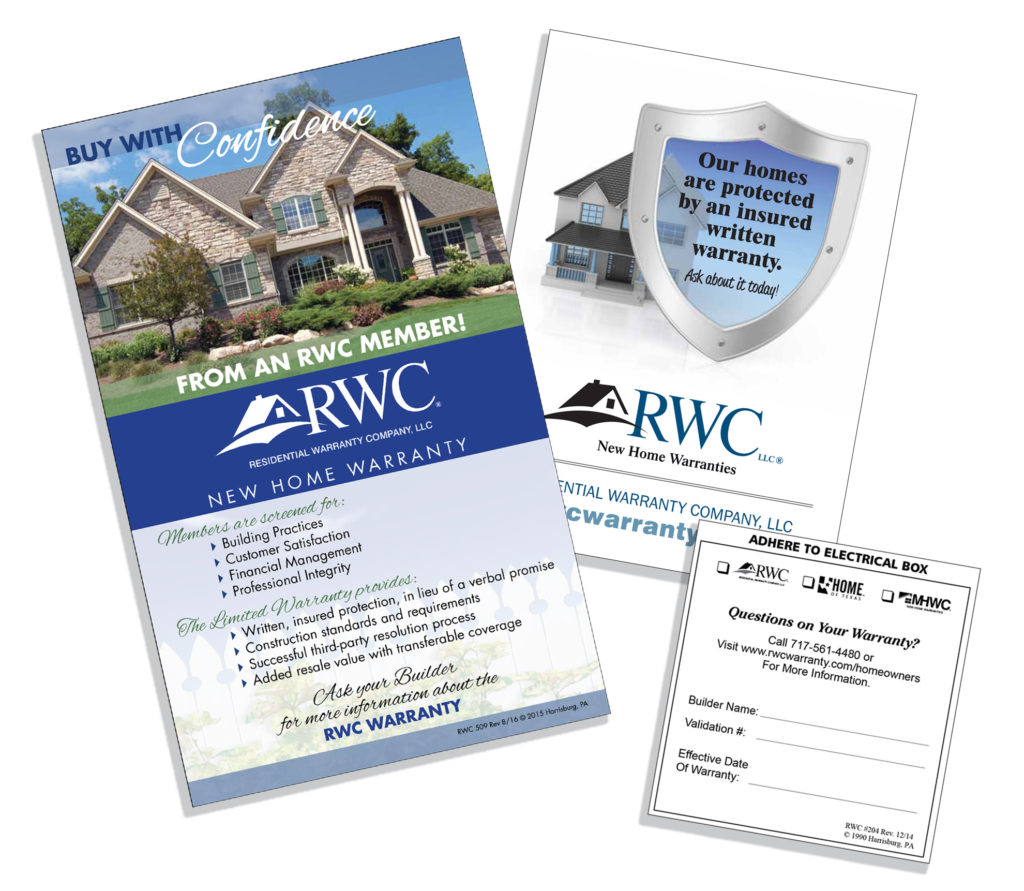 One of the many advantages of your membership in the RWC Warranty Program is the marketing support available for your use. You can enhance your sales strategy for today’s competitive marketplace by taking full advantage of RWC’s marketing essentials. Best of all, they are FREE!
Below are a few examples of what is available, but feel free to browse our marketing materials page to see what best suits your needs. Consumer brochures are also available to pass onto your homeowners so they can better understand the warranty on their home.
- Electrical Box Sticker (form # 204): This self-adhesive sticker makes it easy for your homeowners to find their warranty validation number. Affix this sticker to their electrical box during your final walk-through inspection.
- Small vertical Easel (form # 509): Sometimes space is limited on countertops. When that’s the case and our full-size easel or brochure holder doesn’t fit, try this smaller version. Works great in sales offices and model homes!
- Static Cling Window Decals (form #533): This cling is perfect for windows in model homes, sales offices or even homes under construction. This static cling decal will let your prospective buyers know that their home will be protected with an RWC warranty.
HOW TO ORDER SUPPLIES:
Order Online through Warranty Express (top right corner of webpage). Call us if you still need a password to login.
Email: info@rwcwarranty.com and let us know which items you are interested in.
Phone: 800-247-1812, Ext 2459
We ask that you please order only a 2-3 month supply to ensure that you receive the most current materials.
 If you’ve been a builder for more than a few years you’ve been through a lot. When the housing bubble burst; you survived. Now that the market is better and your business is growing, you’re starting to realize the rewards of surviving. There are still plenty of challenges and one of them is to find qualified subcontractors.
Recently, you started a new subdivision and hired a flat concrete contractor you’ve never worked with before, to put in the sidewalks. This morning you got a call from your new sub; the kind you never want to get. A woman was walking her dog next to your project around dusk last night. She tripped over a mason’s line that was left across a section of sidewalk that had been poured earlier that day. The new flat work guy left the site without setting up any cones, fencing or signs. In fact, he did nothing to warn the public of what is commonly referred to as a “trip & fall hazard.” The woman suffered fractures to both wrists as well as lacerations to her face when she fell. Her injuries will require surgery and she’ll be unable to work for several months. Her pain and suffering have yet to be determined.
Your new sub has his own general liability insurance that should respond to this claim. You required him to have his insurance company add you to his policy as additional insured. That way they will defend you if and when the woman’s attorney sues you as well as your sub. The certificate of insurance you required your sub to provide shows all of this. Everything should be fine. But, trip & fall claims can spiral out of control.
Disputes can arise over who should have protected the worksite. Subcontractors or, their attorneys, can argue that’s the general contractor’s job. You feel that you don’t have time to hover over every job site making sure each sub is placing the proper emphasis on safety. Besides, you hired them to do a job and that includes doing it safely. Doesn’t it? All your subs understand this, don’t they?
In most states, you as the general contractor, are ultimately responsible for worksite safety. That doesn’t mean the subs get a free pass. But it usually means the general contractor has to do more than just assume everyone is being safe. That means holding periodic safety meetings, making sure new subs understand what you expect from them before starting work each morning, during the workday and after shutting down for the night. Active worksites are dangerous places even when they are nothing more than a partially completed sidewalk in poor light where an unsuspecting woman takes her dog for a walk.
Holding regular safety meetings doesn’t have to take a lot of time or cost you much money. Meetings don’t have to be held every day; just regularly enough to make it clear to everyone concerned that you are committed to preventing accidents involving both the public and anyone else at your worksites.
The RWC Insurance Advantage is dedicated to loss prevention. To prove it, we offer up to 25% off your new general liability premium if you provide us with a copy of your written safety program. If you’re already insured with us, we’ll even offer the same incentive on your next renewal if you haven’t already received it.
Call us today at 866-454-2155 to find out if you qualify and receive a free, no obligation quote.
Today’s home buyers are tech-savvy shoppers who routinely turn to the internet when searching for new homes. As a successful builder, you understand the vital importance of maintaining a solid presence on the internet so potential buyers can find you, learn about what you offer, and discover what makes you better than “the other guys”.
 RWC has an entire section of our website dedicated to educating the homebuyer on everything from how to choose a home builder to understanding what a new home warranty is all about. The following resources can help explain the value of your decision to provide an RWC warranty on your home:
- The Value of an RWC Warranty to Your Home Buyer
- What Your RWC Membership Means to Your Buyer
- Tips on Choosing a Builder (of course being an RWC Member factors in there)
- What’s the Difference Between a Structural Warranty and an Appliance Warranty
- Important Warranty Terms to Know and Understand
Something ‘extra’ you provide which sets you apart from the competition is the fact you offer a 3rd party insured warranty – and not just any warranty – but the RWC warranty. The sales process is complex with a variety of topics to discuss with potential home buyers. Our goal is to make the warranty explanation easier for you by expanding our online resources for your homebuyers. Hopefully, this section will become your “go to” resource for warranty information for your staff and your buyers.
Obviously, it makes perfect sense to provide your buyers with information about your warranty. Simply link your site to the RWC Homeowner section to point them in the right direction and we’ll tell the story for you! We suggest linking to www.rwcwarranty.com/homeowners as your starting point. Your buyers will learn about the extra mile you travel to demonstrate your professionalism and customer service by providing them with this written RWC warranty.
 Did you know that as a member of RWC or HOME of Texas you may be eligible for our General Liability Insurance Program through RWC Insurance Advantage? If you would like to learn how we might meet your general liability coverage needs, call RWC Insurance Advantage today at 866-454-2155 or click here to get a quote. Plus, be sure to read on for some helpful hints about certificates of insurance, subs and staying on top of policies.
Insurance agents hear it all the time; are certificates really that important? If my subs’ certificates aren’t current, am I on the hook for what their policies don’t cover? What about exclusions on my policy? Maybe a hypothetical claim will help provide some answers. Let’s say you contract with a roofer. He’s not the roofer you usually work with but, he has a good reputation and he gives you a certificate of insurance that shows he has his own General Liability policy. It has the same limits as your policy with the RWC Insurance Advantage program. No worries here. His policy will respond first to injuries or damage to others that he might cause while working on your behalf. However, you also notice his Workers Comp is due to renew in about a week but, he assures you the renewal is going to happen and he’ll provide you with an updated certificate just as soon as he gets it from his agent. You need to get your latest project under roof as soon as possible because the weather has been uncertain; so, you decide to take a chance. Besides, it shouldn’t take a week to do a roof. What could go wrong?
The weather takes a turn for the worse. By the time the roof is started it’s been over a week. Then you get the news one of the roofer’s employees has been injured. He didn’t fall but, he hurt his back. Only then do you remember the promised certificate hasn’t appeared. Then your roofer admits his policy was not renewed because he failed to make a payment. Your policy doesn’t cover injuries to the employees of subcontractors. That’s because workers compensation insurance is available to them and is designed to cover the medical bills and lost wages of his employees. As it turns out, waiting for a renewal certificate of insurance might have avoided you being held liable for a loss that isn’t covered under your policy.
• Make sure all your subcontractors provide you with up-to-date certificates of insurance.
• Ask them if they have any open or, unreported claims.
• Be aware of what your policy does and does not cover.
Don’t let someone else’s lack of planning become your problem.
Source: nahb.com
Whole house remodels and additions are regaining market share according to a 2016 survey of remodelers released by NAHB Remodelers, the remodeling arm of the National Association of Home Builders (NAHB). The survey revealed the most common remodeling projects in 2016, compared to historical results of the survey.
“While bathroom and kitchen remodels remain the most common renovations, basements, whole house remodels and both large and small scale additions are returning to levels not seen since prior to the downturn,” stated the 2016 NAHB Remodelers Chairperson. “Clients want to add more space, but remodeling a significant portion of the home is no easy feat. That’s why it is important to work with a professional remodeler who has the integrity and expertise to take on these large remodeling jobs.”
 Remodelers reported that the following projects were more common than in 2013:
• Whole house remodels increased by 10 percentage points
• Room additions increased by 12 percentage points
• Finished basements increased by 8 percentage points
• Bathroom additions increased by 7 percentage points
Bathrooms topped the list of most common remodeling projects for the fifth time since 2010. Eighty-one percent of remodelers reported that bathrooms were a common remodeling job for their company while 79 percent of remodelers reported the same for kitchen remodels. Window and door replacements decreased to 36 percent from 45 percent in 2014.
Whether you are currently working on remodeling projects due to the colder weather and frozen ground or because that's what your customers are opting for, Residential Warranty Company, LLC & HOME of Texas have great remodeler warranty options at your fingertips. When it comes to revamping space, creating an addition to a home, or totally reinventing the look and style of a home, homeowners want to know the work is being done by a quality, professional remodeler. Contractors who offer the RWC warranty / HOME warranty provide clients with written, insured warranty protection, including a dispute resolution process.
It takes a lot of tools to both complete a remodeling project and to build a business. RWC / HOME offer you a great selection of tools. Talk to your account executive today for more details on the remodeler warranty, or any program available in our menu of choices.
 Source: proremodeler.com
Readers of news articles about the housing industry have been inundated for a while with stories about Millennials and their desire to live in the city. Headlines such as “Millennials Prefer Cities to Suburbs, Subways to Driveways” and “The New American Dream Is Living in a City, Not Owning a House in the Suburbs” popped up frequently. And polling companies provided the data to back it up: The Nielsen Company, for example, reported that 62 percent of young people “like having the world at their fingertips,” preferring to live in “dense, diverse urban villages where social interaction is just outside their front doors.”
But around the middle of 2015, the stories about Millennials started to shift. We began to see more stories like, “Think Millennials Prefer the City? Think Again …” And now, a survey from the National Association of Realtors says that Millennials are finally starting to buy homes. And where are they buying them? That's right, in the ’burbs.
Why all of a sudden the change? Perhaps Millennials are now ready to settle down and start families and prices are cheaper in the suburbs. Or because they want to raise their kids in places that remind them of their own childhood. Whatever the reasons, the numbers show that buyers under the age of 35 now make up the largest share of homebuyers (35 percent) and that 51 percent of them bought homes in the suburbs or in subdivisions.
It stands to reason that these buyers, whose median age is 30, are the leading edge of their generation. As the rest of this generation, 80 million strong, reach their 30s, they will likely follow the same path—research from the Demand Institute says 75 percent of Millennials consider homeownership an important long-term goal and 48 percent say they plan to buy within the next five years. The question is, are you building homes they will want to buy?
So what exactly does this young group want? Turns out they want pretty much the same things almost everyone else wants: a nice neighborhood; good schools; access to public transportation; & convenient outdoor space to walk and exercise. Another requirement is close proximity to social activities such as shops, cafés, and restaurants. As for the house itself, they are looking for an open plan, ample storage, energy efficiency, low-maintenance living, space for easy entertaining, and of course good cell reception. But the single most important thing Millennials are looking for is living within their means in a home they can comfortably afford.
Unfortunately, the problem is, there just aren’t enough new homes being built that Millennials can afford. Because of land and labor costs, zoning and other regulations, most builders are targeting a smaller, more affluent group of buyers. A lot of new homes are large and include more expensive features and amenities. Something that a young, first time home buyer, will probably pass right by because it is out of their price range. A recent study by real estate advisors RCLCO revealed that when first-time buyers considered new and existing homes in their searches, only 18 percent of them bought a new home.
There are some success stories out there, though. RCLCO reports that a concerted effort by some master planned communities to offer a range of product types, such as townhomes, cottage court bungalows, and small single-family homes—in addition to conventional single-family homes — “can still achieve premiums on a dollars-per-square-foot basis.” The company cites the Daybreak master plan near Salt Lake City as a good example of a project that successfully integrates midscale, mid-priced product within a larger community.
Companies that are building more affordable homes and marketing them to Millennials are already starting to reap the rewards. It’s time for more builders to start thinking about creating a product that is attainable for the largest faction of buyers we may ever see.