
Source: nahb.com
Whole house remodels and additions are regaining market share according to a 2016 survey of remodelers released by NAHB Remodelers, the remodeling arm of the National Association of Home Builders (NAHB). The survey revealed the most common remodeling projects in 2016, compared to historical results of the survey.
“While bathroom and kitchen remodels remain the most common renovations, basements, whole house remodels and both large and small scale additions are returning to levels not seen since prior to the downturn,” stated the 2016 NAHB Remodelers Chairperson. “Clients want to add more space, but remodeling a significant portion of the home is no easy feat. That’s why it is important to work with a professional remodeler who has the integrity and expertise to take on these large remodeling jobs.”
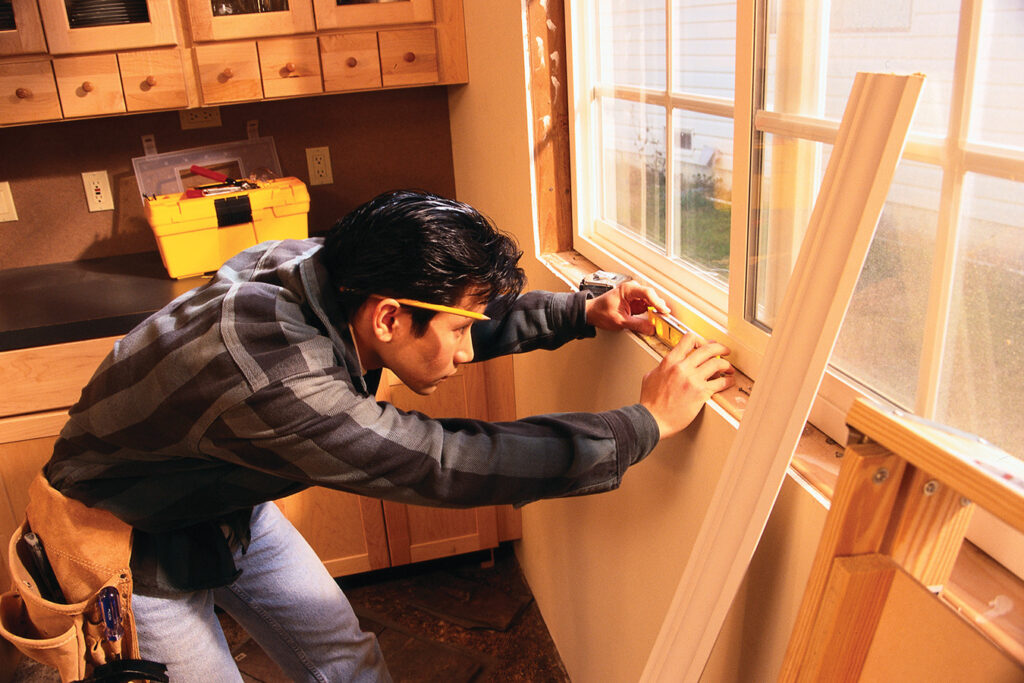 Remodelers reported that the following projects were more common than in 2013:
• Whole house remodels increased by 10 percentage points
• Room additions increased by 12 percentage points
• Finished basements increased by 8 percentage points
• Bathroom additions increased by 7 percentage points
Bathrooms topped the list of most common remodeling projects for the fifth time since 2010. Eighty-one percent of remodelers reported that bathrooms were a common remodeling job for their company while 79 percent of remodelers reported the same for kitchen remodels. Window and door replacements decreased to 36 percent from 45 percent in 2014.
Whether you are currently working on remodeling projects due to the colder weather and frozen ground or because that's what your customers are opting for, Residential Warranty Company, LLC & HOME of Texas have great remodeler warranty options at your fingertips. When it comes to revamping space, creating an addition to a home, or totally reinventing the look and style of a home, homeowners want to know the work is being done by a quality, professional remodeler. Contractors who offer the RWC warranty / HOME warranty provide clients with written, insured warranty protection, including a dispute resolution process.
It takes a lot of tools to both complete a remodeling project and to build a business. RWC / HOME offer you a great selection of tools. Talk to your account executive today for more details on the remodeler warranty, or any program available in our menu of choices.
 Source: proremodeler.com
Readers of news articles about the housing industry have been inundated for a while with stories about Millennials and their desire to live in the city. Headlines such as “Millennials Prefer Cities to Suburbs, Subways to Driveways” and “The New American Dream Is Living in a City, Not Owning a House in the Suburbs” popped up frequently. And polling companies provided the data to back it up: The Nielsen Company, for example, reported that 62 percent of young people “like having the world at their fingertips,” preferring to live in “dense, diverse urban villages where social interaction is just outside their front doors.”
But around the middle of 2015, the stories about Millennials started to shift. We began to see more stories like, “Think Millennials Prefer the City? Think Again …” And now, a survey from the National Association of Realtors says that Millennials are finally starting to buy homes. And where are they buying them? That's right, in the ’burbs.
Why all of a sudden the change? Perhaps Millennials are now ready to settle down and start families and prices are cheaper in the suburbs. Or because they want to raise their kids in places that remind them of their own childhood. Whatever the reasons, the numbers show that buyers under the age of 35 now make up the largest share of homebuyers (35 percent) and that 51 percent of them bought homes in the suburbs or in subdivisions.
It stands to reason that these buyers, whose median age is 30, are the leading edge of their generation. As the rest of this generation, 80 million strong, reach their 30s, they will likely follow the same path—research from the Demand Institute says 75 percent of Millennials consider homeownership an important long-term goal and 48 percent say they plan to buy within the next five years. The question is, are you building homes they will want to buy?
So what exactly does this young group want? Turns out they want pretty much the same things almost everyone else wants: a nice neighborhood; good schools; access to public transportation; & convenient outdoor space to walk and exercise. Another requirement is close proximity to social activities such as shops, cafés, and restaurants. As for the house itself, they are looking for an open plan, ample storage, energy efficiency, low-maintenance living, space for easy entertaining, and of course good cell reception. But the single most important thing Millennials are looking for is living within their means in a home they can comfortably afford.
Unfortunately, the problem is, there just aren’t enough new homes being built that Millennials can afford. Because of land and labor costs, zoning and other regulations, most builders are targeting a smaller, more affluent group of buyers. A lot of new homes are large and include more expensive features and amenities. Something that a young, first time home buyer, will probably pass right by because it is out of their price range. A recent study by real estate advisors RCLCO revealed that when first-time buyers considered new and existing homes in their searches, only 18 percent of them bought a new home.
There are some success stories out there, though. RCLCO reports that a concerted effort by some master planned communities to offer a range of product types, such as townhomes, cottage court bungalows, and small single-family homes—in addition to conventional single-family homes — “can still achieve premiums on a dollars-per-square-foot basis.” The company cites the Daybreak master plan near Salt Lake City as a good example of a project that successfully integrates midscale, mid-priced product within a larger community.
Companies that are building more affordable homes and marketing them to Millennials are already starting to reap the rewards. It’s time for more builders to start thinking about creating a product that is attainable for the largest faction of buyers we may ever see.
 When a builder provides a warranty on a newly built home, what exactly does that mean to your buyer and to you? It means protection, security, peace of mind and value. And a warranty from Residential Warranty Company, LLC will provide just that. One of the least expensive, longest lasting products a builder can purchase for the homes they build is an RWC warranty.
So why exactly is RWC your best choice?
OPTIONS: The RWC “Menu of Choices” allows you the ability to offer the best Warranty program for your business. From our FHA/VA accepted Standard 10 Year Warranty to our Day 1 Coverage Warranty to our Customized State New Home Warranty to our Remodelers Warranty and more, we have what your business needs.
FLEXIBILITY: RWC’s members are able to pick and choose which Warranty options to use and which projects they wish to enroll. We do not require 100% enrollment on detached homes.
MARKETING FEATURES: RWC provides its members with FREE attractive marketing materials to help promote your business and set yourself apart from your competition.
EASY: RWC offers online enrollment, the ability to order marketing materials, renew memberships and run reports through Warranty Express.
EXPERIENCE: RWC has been in business for 35+ years and has warranted over 3 million homes to date. The average tenure of our employees is 18 years.
STRENGTH: RWC’s insurer, Western Pacific Mutual Insurance Company (WPMIC), A Risk Retention Group, is A.M. Best rated “A- (Excellent)”. WPMIC insures only our thoroughly screened builder members and no other catastrophic risks such as planes, trains or automobiles, which can affect an insurer’s strength and equity. Less risk equals more strength. In fact, WPMIC currently has over $111 million in surplus equity.
CREDIBILITY: RWC’s membership criteria presents us with the strongest builder members. This screening process reinforces your credibility as an RWC member.
PROTECTION: RWC offers FREE mediation. When needed, binding arbitration is also available. Both offer effective resolution for Warranty disputes. This reduces your risk of litigation and legal fees.
ADVOCACY: RWC provides support to the Home Building Industry through our involvement and financial contributions as a member of local, state and national Home Builder Associations across the United States.
Our mission is to provide a level of security to homeowners and Builders alike. We can help you in maintaining or improving your customer service, define and limit your liability, and provide the warranty and insurance products your company needs. For more information, don’t hesitate to call 800-247-1812 x2149 or email sales@rwcwarranty.com.
By now we all know it's not a good idea to post sensitive information on social networking sites or blast private data through cyber space without taking the proper precautions. The last thing you want is for private information to be compromised when bouncing from server to server.
Keeping yourself secure from theft and vulnerability is a top priority in today's digital age. That's why Residential Warranty Company, LLC and affiliates HOME of Texas and MHWC have a secure upload portal on each company website for members and prospective members to use in uploading information and important documents to the home warranty companies.
Instead of emailing, faxing or mailing documents for new memberships, renewal memberships or home warranty resolution matters, the upload portal allows for secure transfer of data electronically, efficiently and economically.
Secure upload links can be found in the drop down menu when you hover over the "Builders" tab (or the "Manufacturer's tab on the MHWC affiliate site), as well as at the very bottom of every webpage. Simply follow the prompts to send documents securely. Better safe than sorry!
 In addition to a variety of home warranty programs, RWC and HOME of Texas offers unique features to make your membership as effective and efficient for you as possible.
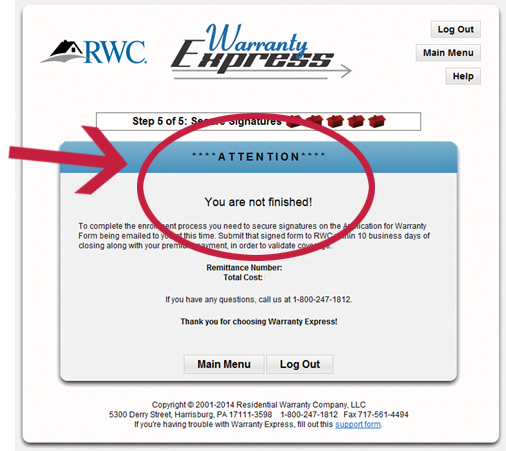
As you know, Warranty Express is our online system for everything from home enrollment to membership renewal to ordering marketing materials and enrollment reports.
We wanted to emphasize an important point about the system when you are enrolling homes online. When you get to the last screen on Warranty Express, it will tell you “You are not finished!”
Why? What do you mean I'm not finished? Well, because we still need the signed Application for Warranty form and payment, if not paid online. (Pay online and save the $6.95 processing fee.)
It’s very important that you submit the signed Application for Warranty form after closing.
The warranty is not valid (even if paid for) if RWC/HOME does not receive the signed Application in order to validate coverage.
If you pay online, the signed Application for Warranty form can be faxed to (717) 561-4494 or emailed to Sandra at Sandra.Sweigert@rwcwarranty.com.
If you are not familiar with Warranty Express, contact your Account Executive for more details.
 Who doesn't love a perk that allows you to reap the rewards of something that you already do... provide quality construction and outstanding customer satisfaction. That's right, cash in on YOUR excellent customer service by joining the Incentive Program!
Joining the Incentive Program is the best way for our Members to maximize their dollars plus enjoy additional benefits that only this program offers.
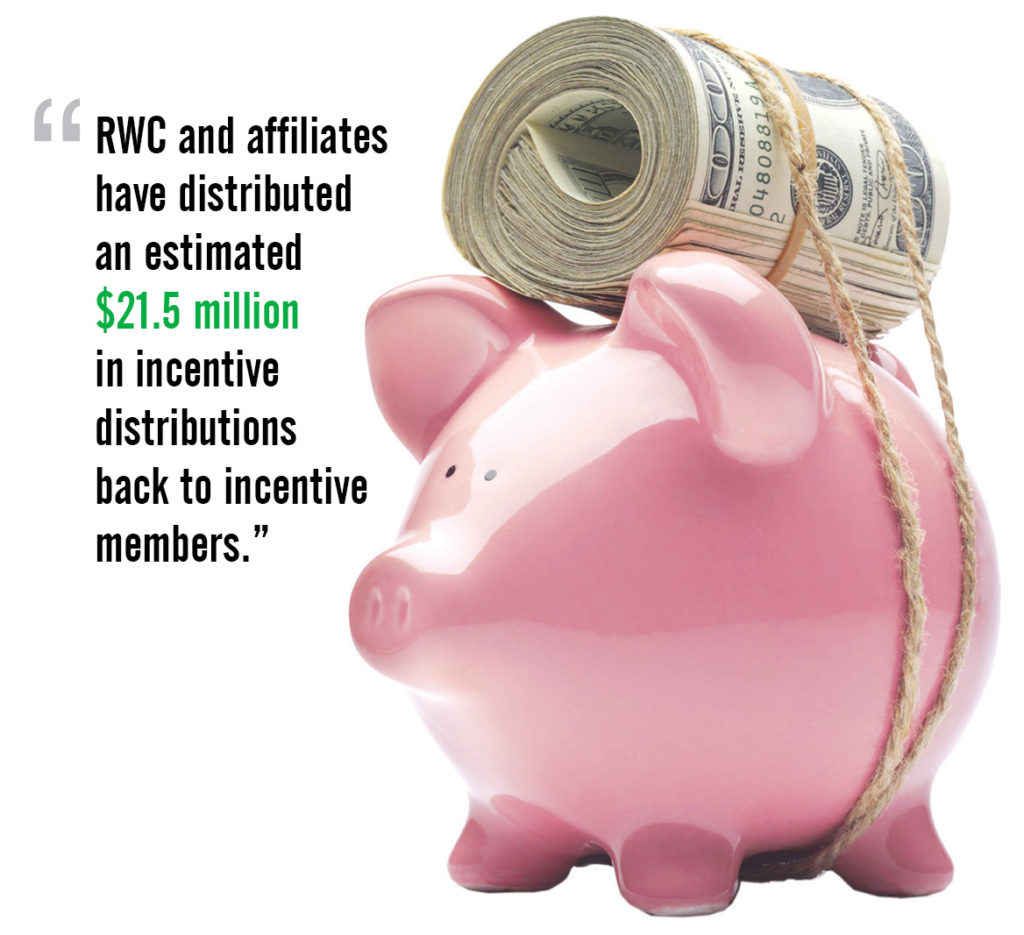
RWC established this program over 25 years ago as a way to reward our members for their good claims experience. Since then, RWC and affiliates have distributed $21.5 million in Incentive distributions back to Incentive members.
WHO IS ELIGIBLE?
A Member must enroll at least 20 homes per year or have an annual enrolled sales volume of $2 million. A free analysis illustrating how the Incentive Program can work for you is available upon request.
ADDITIONAL BENEFITS:
• The annual fee of $295 is waived for Incentive Members, saving an additional $1180 in years 2-5 of membership.
• The value of the Incentive distributions greatly reduces the effective cost of the warranty fee.
• The Member enjoys a locked-in enrollment rate under the standard program throughout the duration of their Incentive membership.
HOW DO I JOIN?
If you think your company will meet the eligibility requirements, call us to take the next step in building your own Incentive reward! Contact us at 800-247-1812, Ext 2149 or email sales@rwcwarranty.com.
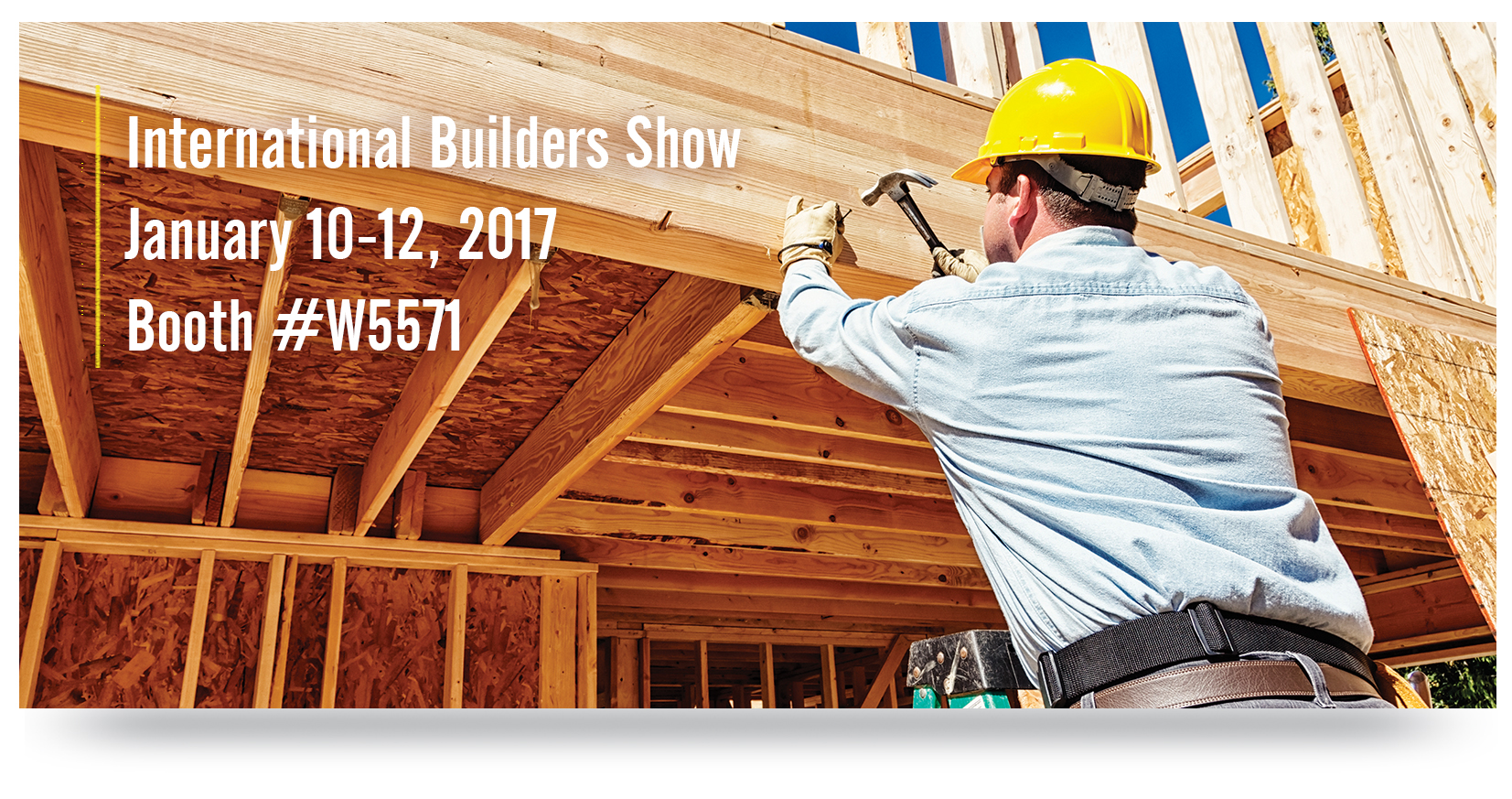 Residential Warranty Company, LLC (RWC), HOME of Texas and MHWC will be attending the 2017 International Builders Show (IBS) in Orlando, Florida January 10-12, 2017. Be sure to stop by booth #W5571 to learn why new home warranties are an essential ingredient for your business. Whether you are a builder, remodeler or manufacturer, providing a new home warranty is a great way to enhance the value of your homes, strengthen your reputation and get a competitive edge in the marketplace.
As you know, it’s not strictly business at IBS. Before you head off to the House Party or the Spike Concert, have some fun with RWC and try your luck at our Wheel-O-Warranty prize wheel! Not only will you walk away with one of many great prizes, but you will also be entered into our grand prize drawing for a $1000 Visa gift card. Celebrate a brand new year with the innovative leader in new home warranties, RWC!
 On August 14, 1173 Bonanno Pisano, began construction on an 183’ high marble and stone bell tower in Pisa, Italy. It took nearly 200 years to complete, but trouble started long before. Within five years of breaking ground, the bell tower began to lean due to a shallow foundation set in unstable subsoil. The design was flawed from the beginning. A builder’s worst nightmare? Just the opposite. Today the Leaning Tower of Pisa is one of the world’s most visited tourist destinations.
For the rest of us less able to make lemonade from the occasional lemons we’re handed, we need help. Fortunately, for Pisa, the tower’s lean hasn’t caused it to fall over on all those cash-carrying tourists…yet. If that ever happens, the contractor responsible for maintaining the famous landmark better have general liability insurance. Otherwise, it could become the world’s most famous uninsured construction defect claim. Of course, the tower has been standing for over 600 years without falling, so what else is there to worry about? Each year in this country more than seven million injuries are attributed to “slip and fall” accidents. Imagine how many tourists may have slipped or fallen going up and down the steps of the Leaning Tower of Pisa. Now imagine how many would-be buyers might slip or fall at one of your model homes or active job sites.
Nobody likes thinking about third party liability claims. Bonanno Pisano didn’t have to because he didn’t live to see his project completed. You’re probably planning on being around for a while and I’m guessing those plans don’t include losing everything you’ve worked for because someone was seriously injured at one of your job sites. If my guess is right, we’d like to help. Give RWC Insurance Advantage a chance to review your current general liability coverage. Call us at (866) 454-2155 and ask for Ron Sweigert or click here for a free no obligation quote.
All of the Builder warranty programs offered by Residential Warranty Company, LLC, HOME of Texas or MHWC feature mandatory binding arbitration of Unresolved Warranty Issues.* RWC and its Builder members have been very successful at persuading courts to recognize and enforce the warranty’s mandatory binding arbitration provision. Courts across the country have removed cases from the courthouse and directed them to arbitration under our Limited Warranty Programs.
A good example can be found in this case study. Residential Warranty Company, LLC (RWC) had issued a warranty on a home, which was in Year 1 of coverage, and the homeowners filed a lawsuit against the Builder. The Builder was well equipped to defend himself with the home warranty book, the application for warranty and his own contract, which included language that made the RWC home warranty, including the warranty’s binding arbitration language, applicable to any alleged warranty defects in the home. Even though the homeowners argued that RWC’s warranty should not be enforced in that state, the court endorsed RWC’s warranty, and the motion brought by the Builder to compel arbitration and dismiss the homeowners’ lawsuit was granted in its entirety.
Consequently, the homeowners initiated a request for warranty performance with RWC. Prior to arbitration, the Builder’s home warranty provides for informal mediation. The parties agreed to use RWC’s mediation to try to settle the disputes about the alleged warranty defects. RWC became actively involved mediating between the homeowners and the Builder. Through this mediation, communication between the homeowners and the Builder improved and several items were amicably resolved. We were encouraged that most, if not all warranty items, would soon be resolved in the same way. At the conclusion of mediation, if any items remained unresolved, the homeowners and Builder would proceed to binding arbitration under the terms of the warranty.
This is a real case and a great example of how RWC’s mandatory binding arbitration provision is an effective tool in preventing litigation. It also supports the value of using RWC’s mediation process to resolve disputes about alleged warranty defects in the homes you build. To get more information on how to best utilize the mediation and arbitration provisions of your RWC, HOME or MHWC builder warranty, contact us at sales@rwcwarranty.com to schedule a Warranty Training Seminar.
*Note that the mandatory arbitration provision is removed by the HUD addendum, and thus mandatory arbitration does not apply to warranties placed on FHA/VA financed homes.