
Unpredictable summer weather can stir up additional concerns amid already challenging times. The warmer weather may bring devastating hurricanes and other natural disasters.
The 2020 hurricane season was very active. By the time all was said and done, the Atlantic Basin experienced 30 named storms. The National Hurricane Center actually exhausted the standard alphabetical list and moved onto the greek alphabet for naming conventions. We can only hope that 2021 does not follow that trend.
Nasty weather causes ripples in many ways of life, including the building industry. Resources are already stretched thin due to supply chain issues and material shortages. If you haven’t done so already, now is the time to start preparing for upcoming potential threats.
The National Association of Home Builders (NAHB) recommends businesses have a solid plan in place that covers everything from suppliers to staffing and even bracing for worsening economic impact.

The NAHB sheds light on several things to consider when planning your operations during natural disaster season.
For the housing industry, some examples of COVID-19-related impacts that should be taken into consideration during business continuity and preparedness planning this hurricane season include:
Personal Protective Equipment (PPE) supply chains: Plan to communicate frequently with any current PPE suppliers to gauge the availability of masks or anything else imperative to your business.
Workforce disruptions: A major storm or natural disaster could have a major impact on local labor at a time when COVID-19 has already heavily influenced many companies staffing levels.
Supply chain and material availability and scheduling: Many suppliers have seen extended backorders for certain building materials and adjusted delivery procedures according to social distancing measures and this may be further affected by a severe weather event.

Non-congregate sheltering options for employees and their families: Should an evacuation be ordered, or external sheltering be needed for a hurricane or tornado, plan for contingencies that allow for adherence to local social distancing requirements.
Communication and virtual infrastructure: As with any major weather event, local electric and telecommunications infrastructure can sustain damage resulting in outages. These outages could be extremely detrimental to operations during the pandemic as many companies are already conducting most business virtually or over the phone. Be sure to have robust communication plans that include multiple pre-established contact channels for employees and virtual infrastructure backups to support any virtual construction-related technologies that were adopted as a result of the pandemic.
Economic impacts: The effects of the global pandemic have heavily impacted many companies’ financials. During business continuity and preparedness planning, account for how a major business disruption caused by a natural disaster could impact any COVID-19-related loans or federal aid.
Limiting personal exposure when evacuating and restarting operations: From securing the worksite or office, to evacuations, and eventual return to normal operations, planning for appropriate social distancing and safety measures will be important to plan for this upcoming season.
Ever REALLY wonder why you buy insurance? Many states require you to carry General Liability to maintain a license. Other entities require proof of insurance before you begin any project. The list of those requiring proof of “liability” insurance is long. If you think about it, all that money just to satisfy these demands is frustrating. On top of that, there are builders who have been in business for decades who have never had a “third party” claim. So, what is the real value of General Liability insurance?

Think of it as insurance against “WHAT IFS.” What if a prospect for a home visits your office and trips and falls over a loose rug, fracturing her wrist? What if a subcontractor fails to install flashing around some windows and the homeowner sues you for the resulting water damage years later? What if the person you hired to manage your website posts damaging information about your main competitor and you’re sued for libel? What if a guest at your BYOB holiday party has too much to drink and causes a serious accident on the way home?
If you’re thinking the list of “what ifs” could go on indefinitely, you’re beginning to see just how “general” general liability can be. At the risk of over-simplifying, when it comes to general liability insurance, unless it’s excluded, it’s covered.*
Most people think “sure those things can and do happen, but what are the odds they’ll happen to me?” That’s a reasonable question, but it doesn’t take proper account of the facts. The US Bureau of Labor Statistics and the Centers for Disease Control report the following facts about the most common type of claim:
• 16% of all injuries across all industries are the result of slips, trips and falls.
• 700 fatalities occur each year due to slips, trips and falls.
• $30,000 is the average cost of a slip, trip or fall accident.
• Snow, ice, rain, spills, loose mats, rugs and stepladders are the most common causes of these accidents
“What if” scenarios are endless. Here are two more that everyone should consider: (A) What if you are sued in a liability claim? Do you know what your policy covers? (B) What if your limits aren’t adequate to protect your assets? Can your business survive?
Call us today at 866-454-2155 to discuss your coverage needs. You can also check us out online at www.rwcinsuranceadvantage.com
Stay safe!
(*Not all “what ifs” mentioned in this article would necessarily be covered. Please read your policy carefully to know what coverage you have.)
Builder members with Residential Warranty Company (RWC), HOME of Texas, and MHWC are an elite group. Your membership indicates that you are committed to adherence of strict quality guidelines and that your business is financially sound. But are your homeowners aware that you are also including coverage backed by one of the strongest insurers in the nation? Do they know if tragedy hits and businesses close, that they will still be covered?
Partnering with RWC & Affiliates was a big decision for you to make and your loyalty as a member is reciprocal. As a part of this relationship, our role includes reducing your liability, providing peace of mind for your clients, and helping you grow. With that in mind, we realize that sometimes tools in your toolbox can fall to the back of the drawer and unintentionally be forgotten.

Part of your benefit as a member includes access to numerous, full-color, high-quality, FREE marketing materials. These materials are available to you in a multitude of formats. For your online presence, we can provide web-ready graphics, email & social media compatible logos, proper wording to use, etc. – You name it! If you prefer more traditional, hands-on materials, you can select from numerous flyers, brochures, easel signs, and decals, all ready for your use. Our goal is to offer you pretty much anything you might want or need to help you stand out as a builder.
Recently, you may have seen a few emails from us containing samples of marketing materials. These emails included some of the newer, more updated, options that we offer. If you have missed any and would like to see what is available, there are a few ways we can connect:
1) Reach out to your Account Executive (AE) and ask for help!*
2) Search within your Warranty Express Access – Simply click on the button for Supplies.
3) Review options online here
*The primary advantage of contacting your AE is that they can match you with the best available materials. If you are unsure who your rep is, click here.
One thing we pride ourselves on is the quality of the marketing materials offered to you at no cost. Our goal is to not only help you become more successful but to also help you shine as a competitor in your industry. With all the home building choices available to a future homeowner, the difference can sometimes just boil down to a few small things. If your competition does not offer a warranty, that is an easy win. If they do, then, for example, you could offer them one of our flyers spotlighting our strength and tenure which may help push them in the right direction.
Overall, a quality marketing and advertising campaign is a make-or-break part of any strong business plan. It is a crucial part of conveying your message and appealing to your customers. By including our warranty with your homes, you are giving your buyers the gift of reassurance along with a quality home. We are here to help you get set up with the best marketing tools, tools designed to ensure your buyers fully understand that they are in good hands.
Get in touch today and let us get you set up for marketing success!
Stay up-to-date with the Warranty Company, Upcoming Events, & Industry News.
(Click image to download newsletter)
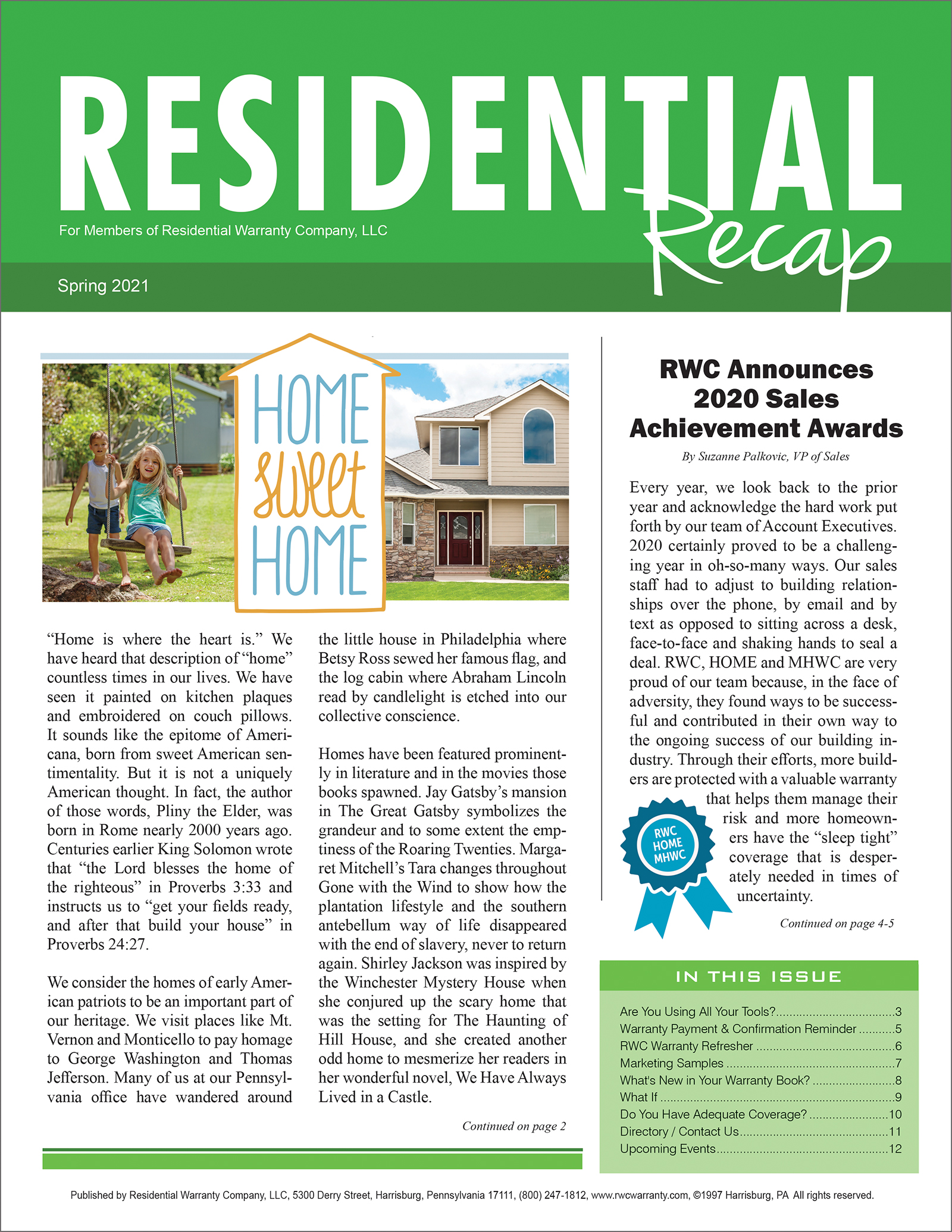

“Home is where the heart is.” We have heard that description of “home” countless times in our lives. We have seen it painted on kitchen plaques and embroidered on couch pillows. It sounds like the epitome of Americana, born from sweet American sentimentality. But it is not a uniquely American thought. In fact, the author of those words, Pliny the Elder, was born in Rome nearly 2000 years ago. Centuries earlier King Solomon wrote that “the Lord blesses the home of the righteous” in Proverbs 3:33 and instructs us to “get your fields ready, and after that build your house” in Proverbs 24:27.
We consider the homes of early American patriots to be an important part of our heritage. We visit places like Mt. Vernon and Monticello to pay homage to George Washington and Thomas Jefferson. Many of us at our Pennsylvania office have wandered around the little house in Philadelphia where Betsy Ross sewed her famous flag, and the log cabin where Abraham Lincoln read by candlelight is etched into our collective conscience.
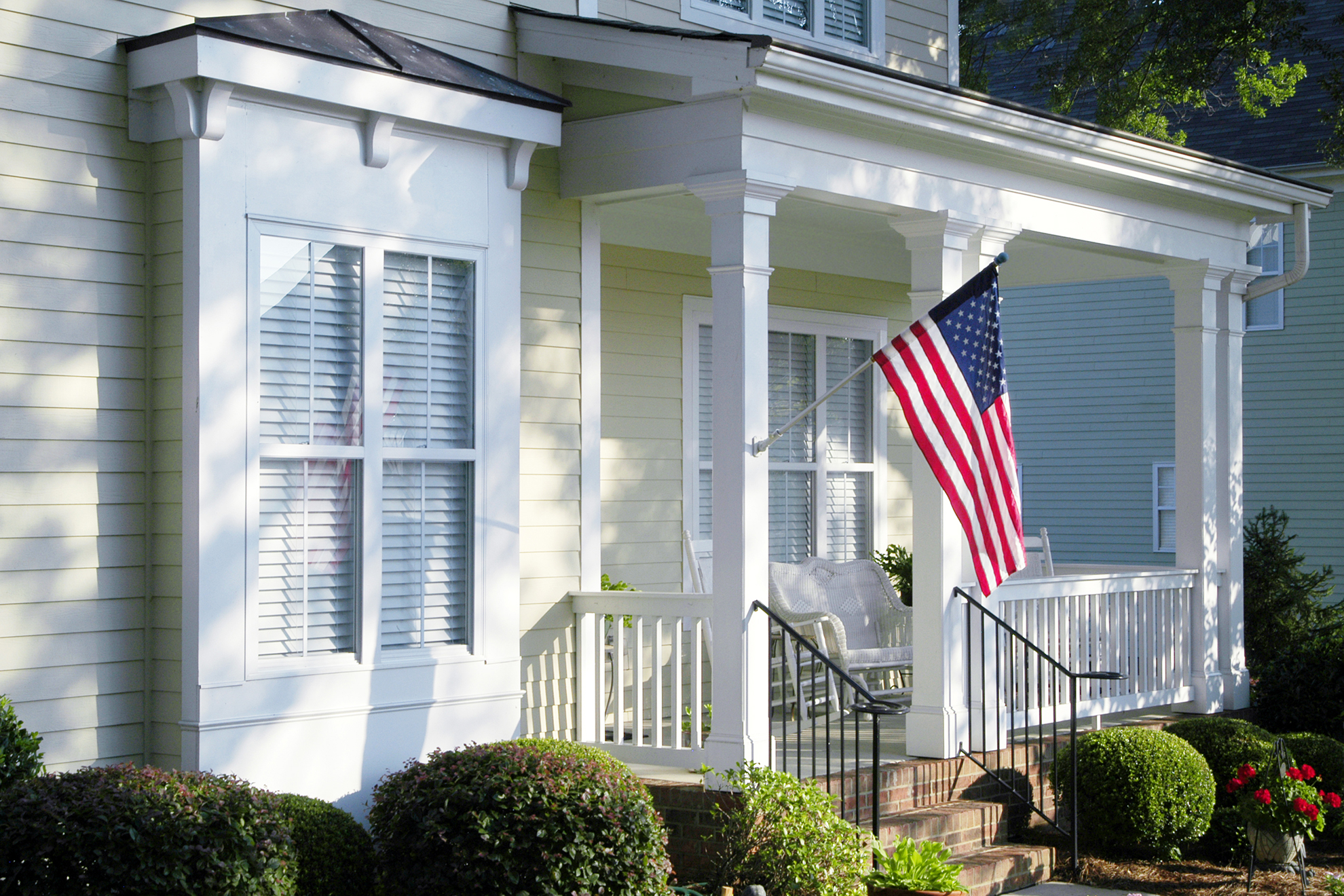
Homes have been featured prominently in literature and in the movies those books spawned. Jay Gatsby’s mansion in The Great Gatsby symbolizes the grandeur and to some extent the emptiness of the Roaring Twenties. Margaret Mitchell’s Tara changes throughout Gone with the Wind to show how the plantation lifestyle and the southern antebellum way of life disappeared with the end of slavery, never to return again. Shirley Jackson was inspired by the Winchester Mystery House when she conjured up the scary home that was the setting for The Haunting of Hill House, and she created another odd home to mesmerize her readers in her wonderful novel, We Have Always Lived in a Castle.
Many of us can recall as youngsters watching television shows featuring homes where the young characters grew up and thrived. The Little House on the Prairie was where good parents taught their children valuable life lessons and where Laura Ingalls proclaimed, “Home is the nicest word there is.” And most of us were touched by the love and homespun wisdom that was regularly on display in The Waltons’ poor yet idyllic home on Walton Mountain.
As inspiring, scary, or enchanting any of those homes are, however, the homes that mean the most to us are the ones where we grew up or in which we raise our families. The hundred-year-old brick house I shared with my five siblings and my parents when I was kid is such a home, and I fondly remember each nook and cranny of it. The large inside window seat at the front of the house is where we would perch to wait for our parents to come home from work or watch for the doctor’s car to pull up if one of us was sick. My grandmother gave me a fish tank one Christmas, and my parents let me put the tank on that seat where it stayed until I grew tired of keeping fish and the last one died.
There was an old closet under the steps where we kids kept our toys. I recall throwing my baseball glove in there when football season would start. By the next baseball season the glove would work its way to the back of the closet, and I would dig through basketballs, football helmets, rubber boots, and hockey sticks until I’d get to my glove. The closet was a kind of calendar, and if I was digging my glove out, it meant that spring was about to arrive.
All eight of us would pack into our kitchen for meals, and afterwards our father would show us an interesting story in the newspaper, or an older sibling would ask about a car advertised for sale or about a job she saw in the help wanted ads. We would gather in the living room at night, our father usually laying on the floor and our mother perching nearby next to the radiator to keep warm, each of them leaving the chairs and the couch for their children to use. When my oldest brother left home, I was given his bedroom on the third floor, the first time I had my own room. My parents bought me a can of paint. I remember painting the room blue and feeling like I had arrived.
I have seen or read about many grand homes in my lifetime, but I would not trade my memories of that old house on Water Street to have lived in any of them.
Builders are uniquely positioned to influence the lives of not just their customers, but of every family who will ever live in the homes they build. There is probably no other product that affects so many people over such a long period of time. You might build a home where a future president, the first person to walk on Mars or the doctor who discovers the cure for cancer grows up. But even if you don’t, you will build homes in which children will be nurtured, where important life lessons will be taught and learned, where joy can abound, and where memories will be created that will last multiple lifetimes. What a great business to be in and what a noble calling!

We are proud of our builders. We know how well they ply their craft, and we know they want to provide the best homes for their customers. Here at RWC, we believe the best home you can build is one that is backed by an RWC warranty. We are biased, of course, but we believe that, if you compare us to the competition, you will arrive at the same conclusion.
At RWC, we have four decades of experience offering our members a wide variety of warranty options, from the standard ten-year warranty to our Day 1 coverage warranty, from our extended appliance and system warranties to our specialty warranties for remodeling projects, and commercial construction. Only RWC has developed a customized state warranty that mirrors each state’s statute of repose and accommodates other state specific issues. Every guarantee our warranties make is backed by Western Pacific Mutual Insurance Company, RRG, an A- A.M. Best rated company that only insures home warranty and similar new home construction risks, like builders’ general liability, which can be offered through the RWC Insurance Advantage program to RWC members. No other warranty company can boast an insurer with this kind of strength that is solely dedicated to covering builders and warranting the performance of their homes.
We appreciate your business, your confidence in us, and your commitment to building great houses that generations of Americans will call home.
Have a great spring and summer!
Stay up-to-date with the Fall 2020 Issue of the Residential Recap.
(Click image to download newsletter)
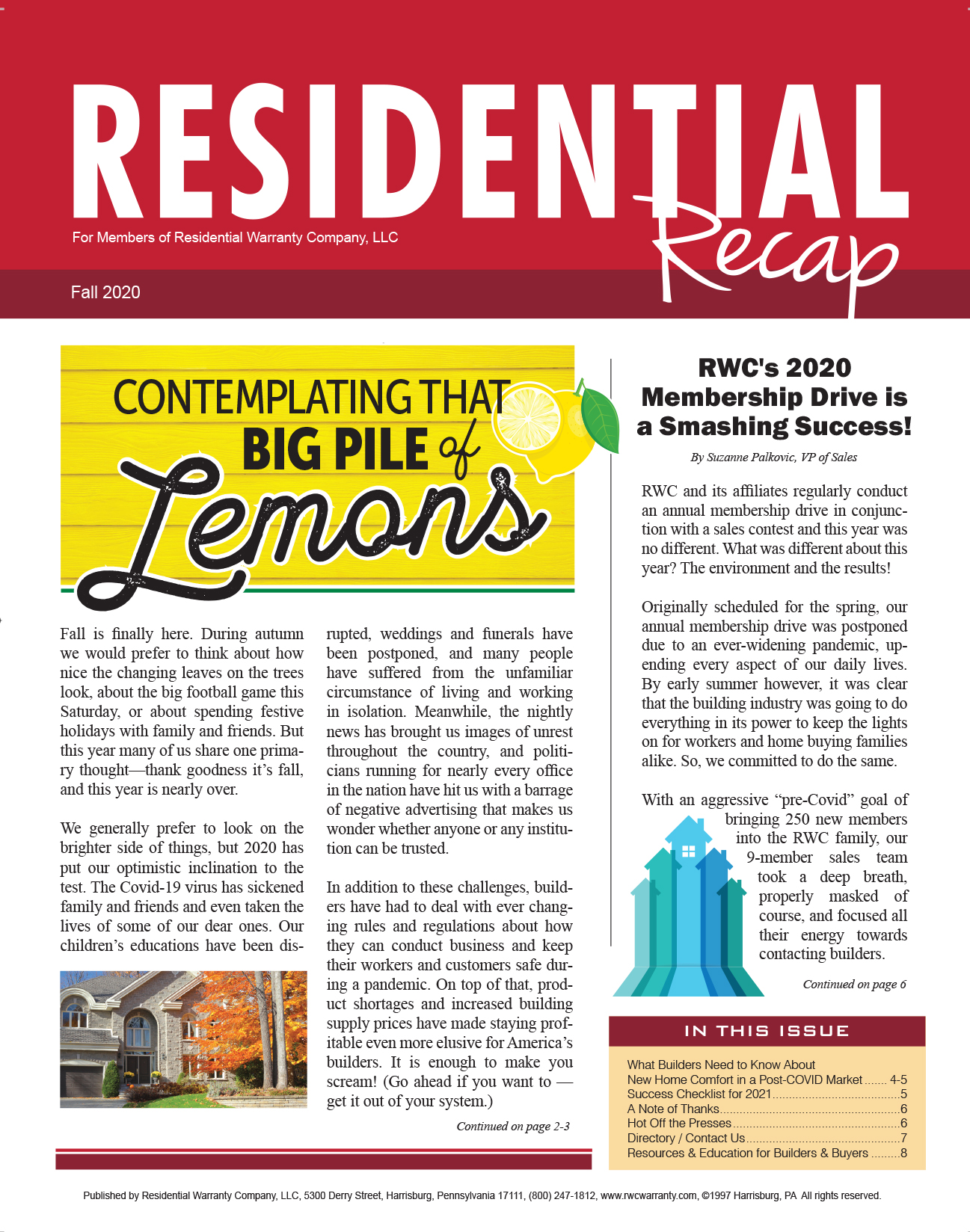
Fall is finally here. During autumn we would prefer to think about how nice the changing leaves on the trees look, about the big football game this Saturday, or about spending festive holidays with family and friends. But this year many of us share one primary thought—thank goodness it’s fall, and this year is nearly over.
We generally prefer to look on the brighter side of things, but 2020 has put our optimistic inclination to the test. The Covid-19 virus has sickened family and friends and even taken the lives of some of our dear ones. Our children’s educations have been disrupted, weddings and funerals have been postponed, and many people have suffered from the unfamiliar circumstance of living and working in isolation. Meanwhile, the nightly news has brought us images of unrest throughout the country, and politicians running for nearly every office in the nation have hit us with a barrage of negative advertising that makes us wonder whether anyone or any institution can be trusted.
In addition to these challenges, builders have had to deal with ever-changing rules and regulations about how they can conduct business and keep their workers and customers safe during a pandemic. On top of that, product shortages and increased building supply prices have made staying profitable even more elusive for America’s builders. It is enough to make you scream! (Go ahead if you want to —get it out of your system.)
At times like these, it is good to consider some of those pearls of wisdom that have helped generations of Americans hold it together when the going gets tough. One of these is a simple admonition I first saw decades ago on a poster hanging on a high school English teacher’s wall: “If life gives you lemons, make lemonade.” I have read or heard it hundreds of times since then. Its point, of course, is that no matter how bad the hand that is dealt to us, we should try to make the most of it. There is no exception in the “Lemon Rule” rule for pandemics or for the chaos caused by pandemics. Indeed, throughout history, people have found ways to learn from pandemics and improve post-pandemic life because of the lessons they learned.
The nineteenth-century world was regularly visited by cholera epidemics. London lost 10,000 of its citizens in 1854 alone. Although Dr. John Snow had determined that raw sewage leaking into a public well was the cause of the 1854 outbreak, most people, including most scientists, believed that “bad air” caused cholera and similar maladies. Fortunately, the method for eliminating the bad air, construction of a modern sewer system, also eliminated much of the contamination that had actually caused the outbreaks. Consequently, London, as well as Paris and cities across Europe who followed suit, became healthier and more pleasant places in which to live and work.

The United States was not immune from cholera’s deadly sting and was ravaged throughout the 1800s by repeated bouts of sickness and death. After Frederick Law Olmsted lost his eldest son to cholera, he vowed to make New York City a safer and healthier place so that other families did not suffer similar fates. He believed that urban areas should have parks that could act as community lungs to blow foul air out of the cities. Olmsted helped design New York City’s Central Park, which was so well received, that he was commissioned to help create more than a hundred other parks in cities like Boston, Chicago, and Detroit.
The so-called Spanish Flu pandemic of a century ago is believed to have killed more than 50 million people worldwide. In India tens of millions contracted the disease, including Mahatma Ghandi, who survived, while 18 million of his countrymen perished. The Spanish Flu pandemic made it clear to Indians that their colonial rulers, the British, had allowed the country’s healthcare system to deteriorate to a point where it was ineffective in dealing with the outbreak. The grief over their losses and the bitter belief that its British rulers were complicit in those losses caused many natives to join Ghandi’s push for independence that eventually ended Britain’s 200-year rule of India in 1947.
In the US, around 650,000 people died from the Spanish Flu during the pandemic. Following and as a result of the pandemic, America created an improved public health system and developed a more organized system for collecting health care data, both of which were the envy of the world, and became a world leader in the study and understanding of viruses. Americans who survived the pandemic faced their next few years with a great sense of optimism that led to the Roaring Twenties and a great expansion of the American economy.
Our world has faced pandemics before. From their piles of lemons, those people, cities, and nations chose to make grand parks and better sanitation, improved healthcare systems, and a free and independent nation. How does this apply to home builders and warranty companies? While our scope and reach are more limited than those of great cities and nations, like them we can observe what is happening around us, learn from these experiences and adapt our behavior accordingly.
So, what can we do with this pile of lemons that 2020 has visited on us? Here are a few ideas.
Better utilize your staff.
A friend of ours, John, who operates a great building company in our area, told us that the pandemic has given leaders among his staff an opportunity to shine while allowing others to demonstrate that they can be trusted team players. Others have shown him an ability to solve problems that he would not have seen but for some of the unique difficulties presented by the pandemic. At RWC we have learned that some of our employees work great independently and, like John’s staff, are very good at problem solving. All of us should take stock of how our people have performed during these difficult times, and when things return to normal, put them in positions that take advantage of the strengths they have exhibited.
Do Business Using State-of-the-Art Technology.
We all can find the rut of years of working a certain way comfortable, or at least more comfortable than changing to something new. The pandemic and some governmental impositions arising from it have forced many of us to work remotely, meet virtually and review and sign documents electronically more than we ever have. At first this was inconvenient for some and downright scary for others. As time has passed, however, people have embraced the efficiency provided by these technologies. They can be time savers not just for you but for your customers as well. When the world gets normal again, do not forget the time and cost saving benefits of these technologies, and don’t wait till the next pandemic to embrace new ones.
Be Open to New Home Building Methods.
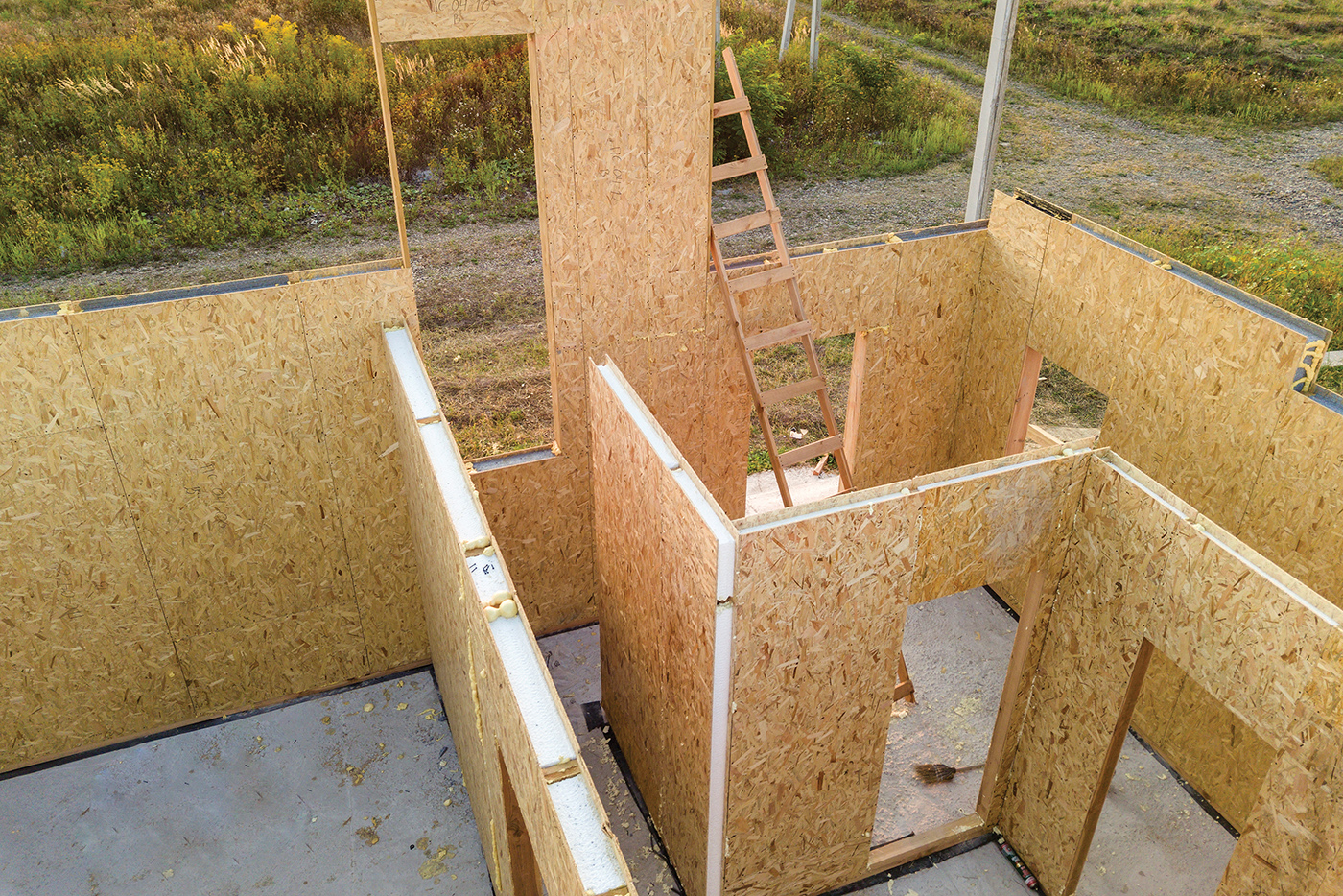
Necessity is the mother of invention, and challenges presented by the pandemic, like building a house while practicing social distancing, have generated new ways to go about it. Big data, artificial intelligence, the internet of things and robotics, according to some, will be used in building most houses someday. Proponents of these processes argue that the time is now to change construction practices, as these methods, together with a greater reliance on prefabricated building segments, will give us a safer, quicker and more profitable way to build quality housing on a more predictable schedule.
Watch for and Take Advantage of Changes in the Marketplace.
Experts predict that some city dwellers will want to move to the suburbs and that some suburbanites will want to move to the country because of the pandemic. Others foresee a demand for changes to the standard house, like higher quality ventilation systems to help exchange air and thus reduce the ability for a virus or other pathogen to spread. Builders should be prepared to go to where the market is and build what post-pandemic customers want.
Succeed During the Optimistic Period that will Follow the Pandemic.
After Americans survived the Spanish Flu pandemic, they rejoiced and ushered in ten years of high rolling, high spending good times. There is no guarantee that will happen again, but we would not bet against it. After effective therapeutic drugs and vaccines are developed to neutralize the COVID-19 virus, be ready for the Roaring 20s 2.0, and position your company to succeed in that environment.
One way to achieve success now or in the future is to place an RWC warranty on each of your homes.

At RWC, we have nearly four decades of experience offering our members a wide variety of warranty options, from the standard ten-year warranty to our Day 1 coverage warranty, from our extended appliance and system warranties to our specialty warranties for remodeling projects, detached garages, and commercial construction. Only RWC has developed a customized state warranty that mirrors each state’s statute of repose and accommodates other state-specific issues. Every guarantee our warranties make is backed by Western Pacific Mutual Insurance Company, RRG, an A- A.M. Best rated company that only insures home warranty and similar new home construction risks, like builders’ general liability, which can be offered through the RWC Insurance Advantage program to RWC members. No other warranty company can boast an insurer with this kind of strength that is solely dedicated to covering builders and warranting the performance of their homes.
We appreciate your business and your confidence in us. And so, in your honor, we’ll raise a glass of lemonade and say good riddance to that big pile of problems 2020 gave us and hope we can all learn from them to be more successful next year! Have a great fall and winter!
In the first quarter of 2019, over 400,000 homes in the U.S. were LEED certified. To join in on this amazing cause, try practicing green building or green home remodeling.
An eco-home is one that’s friendly to the environment. In this case, the environment stands for soil, atmosphere, people living and passing by, other buildings and so forth. An eco-home considers factors like energy, carbon footprint, expenditure, and promotion of local materials and technology.
6 Green Home Remodeling Tips to Build an Eco-Home
To achieve an eco-home, here are six tips to take on.
1. Install a Thermostat
A thermostat will help you regulate temperatures in your home to avoid overheating or extreme cooling. Once you connect a thermostat to most of your electronic devices, you’ll realize a significant decrease in the use of electricity. Fans and heaters won’t have to run all day — slashing down your electric bills.
The best part is the availability of smart home thermostats that can be controlled from your mobile device, and from anywhere you are. Get one that can detect your departure and automatically adjust the temperature of your home.
2. Increase Natural Light with Skylights
Green home remodeling doesn’t have to be all boring and gloomy. There are several ways to maintain an eco-friendly home and keep it as elegant as possible. Such ways include the addition of skylights in certain rooms of your home.
Adding skylights might be a bit expensive, hence essential to only add them in main rooms like the kitchen and living room. They add natural light to the room and increase warmth in the house. A well-lit house brings so much life to the home making it appear spacious and comfortable.
Skylights will reduce the usage of lamps and electricity throughout the day, saving you energy. When installing skylights, fit them with automated blinds to block or regulate sun rays into the room.
3. Go Hardwood
Hardwood is known to be one of the greenest types of wood available. This makes it best for flooring and furniture. However, before purchasing hardwood, ensure the wood is certified by the Forest Stewardship Council (FSC). FSC always ensures that businesses acquire reasonably sourced woods that in turn, maintain our forests green.
Hardwood can also be used for panels and cabinets. This is not to limit its usage. Go creative with the wood and improvise it in different sections of the house. Make wood vases, wood stands like shoe stands and the like.
4. Get Rid of Old Electronics
Nothing eats up your energy like old appliances that take twice the time to deliver a service. Electronics like refrigerators are known to be quite costly. However, a good refrigerator will:
- Last long
- Save on your energy bill
- Decorate your kitchen
It’s an eco-friendly home makeover win for you. Also, you only buy it once making the expense entirely worth it. However, don’t go replacing all 2-year old appliances. Only replace those that are worn out and seem not to be functioning.
Some appliances can be repaired. Therefore, consider that option before replacing with a new one to save on money as well.
Also, try and acquire appliances of new models. This is because newly manufactured electronics are designed to save energy as compared to old-age electronics. If you have an old model washer/dryer, sell it and purchase a new model.
To save more on purchases, look into rebate programs, brand offers, and the like. You can also purchase second-hand appliances that are still under their warranty. This will be way affordable and yet efficient for your home.
5. Go Solar
One of the best green renovation projects is going solar. If your budget fits solar panels, then this will be the best way to go. If not, you can apply some changes to your home, such as the previously mentioned skylights.
You can also install a solar chimney that’ll help improve your home’s ventilation and heating. Smart blinds are a good investment too — they automatically open and close with a change in temperature and light.
During the summer, the sun can be your worst enemy. To avoid constant conflict, you can plant temporary trees in your yard to block rays from getting into your home. Generally, focus most of your home remodeling on the rooms that regularly receive sunlight.
6. Switch Your Paint
Yes, most people don’t know a paint job can be eco-unfriendly. There’s a chemical in certain paints known as volatile organic compounds (VOC) that comes from petroleum-based solvents used during the manufacturing of the paint. It is known to evaporate from the paint at certain temperatures and into the home atmosphere, which is harmful to home appliances and your family members.
There are paints with low VOCs and others with none. These are the paints you should purchase for your home. Such paints use water in place of the VOC making the paint harmless to the environment.
On the same note, petroleum is a non-renewable resource. Therefore, using low VOC or no VOC paints adds to an eco-friendlier home.
Green Home Remodeling Bonus Tips
Green home remodeling doesn’t always have to be expensive. Borrow what you can, improvise what you have, and make use of offers and discounts in the market. You can hire a professional contractor to help remodel your home and turn it into an eco-friendly space.
Gearing up for the remodeling season? Prove that you’re top-notch by offering your clients insurance-backed protection from RWC. Contact us for a quote on a Remodeler Warranty.
Your home construction company and many others like it are critical components of the U.S. economy. Did you know that the construction industry contributes about four percent of the U.S. GDP?
During the first months of 2019, GDP from construction was approximately more than $642.8 billion. While far from the record high of $794.5 billion in early 2005, it’s above the 2005 to 2019 average of $629.67 billion. The market is expected to continue thriving, too.
These statistics point to an accepting environment for those growing or starting a building company.
Is It Time to Expand the Reach of Your Home Construction Company?
If you’ve been running a successful home building company for a while, you may be considering expansion. Growth is good, but be careful not to grow too quickly.
Leveling up already successful construction business models don’t always work out. Some practices that make sense and fit together perfectly right now may not translate on a bigger playing field. You may want to wait until you have the experience and resources to keep your business running smoothly while transitioning to a larger stage.
How Do You Encourage Business Growth While Running a Successful Building Company?
There are best practices to follow when growing any business venture: Be careful with your finances, be prudent about risky opportunities, be ahead of your competition, and be open to change.
Below are more tips that may serve you well and help you lay the foundation for effective and easy growth. Here’s all you need to know about growing a building construction company.
1. Maintain a Healthy Core
Healthy growth comes with a healthy core. Don’t re-allocate time, money and effort for expansion if they are necessary to keep your company at full strength right now. Spreading yourself too thin to support more sales is not a great indication of company health.
Do a comprehensive assessment of your company, too. An in-house evaluation should be your first step.
Establish trust and honesty among your staff members and create an environment that is open to constructive criticism and feedback. Include leadership positions in performance assessments to show that no one is above accountability.
2. Embrace Connectivity and Technology

Does your building construction company use a productivity application or a cloud-based enterprise platform? Using technology and internet-based solutions is no longer optional.
You may be surprised by how much technology can eliminate waiting periods, travel expenses, and manual data entry. You may find your existing staff easily handling more clients.
Instances of miscommunication and misfiling will dip. If areas of your office are devoted to keeping physical records, you may soon find that space freed up for new hires and new equipment.
3. Seek Funding for Higher Operational Costs
You may be lucky enough to have built up a financial cushion to support business growth, but this situation is not the norm. Many small-scale ventures can’t sustain a regular cash flow during the beginning of an expansion—particularly when delays pile up unexpectedly.
To obtain more funding, consider cutting some overhead expenses and optimizing operations. This strategy can only go so far, though. You may need to look into getting a working capital loan.
4. Hire People with the Right Attitude
Your building construction company will eventually reach a point in its growth where you will need to hire more people.
It is tempting to pick applicants with the most work experience. However, it’s more prudent to assess potential hires based on how well they handle workloads and how they interact with clients and staff.
This doesn’t mean that you should hire unskilled workers. You should always look for the best available talent—but your criteria should include more than what can be read on a professional resume.
5. Focus on Customer Service
Running a successful building company necessitates great customer support. Generating more sales and widening your network relies on your good reputation and ability to provide references.
As a building construction company, your interactions with them can coincide with milestone moments for your clients. Satisfied customers will remember you long after projects are completed, and disgruntled ones more so. Make sure that your employees provide quality customer service.
If your clients don’t feel taken care of and valued, you may not grow as fast as you expect. Effective growth runs on both optimized work mechanisms and genuine interpersonal relations.
6. Launch a Marketing Campaign
Marketing your building company can be challenging with several competitors already established in your locale. It’s not impossible, though, with a great reputation and satisfied former clients to back up your marketing campaign.
Consider emphasizing a specialty or marketing to a niche audience. You may even ask your past clients for input regarding what they feel could be a great selling point or utilize them by implementing a referral program.
You must match your ambition for growth with an investment in a professional marketing strategy. You don’t want to work hard to get your company to a point where it’s capable of taking on more work, only to find no clients knocking on your door.
Can Third-Party Companies Help Grow Successful Construction Business Models?
Even massive establishments with sprawling networks and huge workforces may opt to work with third-party companies instead of creating in-house solutions. When in the middle of a growth cycle, it’s more important to concentrate on what your clients expect you to do best.
As with marketing strategies, home staging arrangements, and more, many contractors trust third-party companies to handle warranty plans to go with the homes they build. Residential Warranty Company, LLC offers a variety of warranty products for builders all over the United States. Contact RWC today to receive a warranty quote.
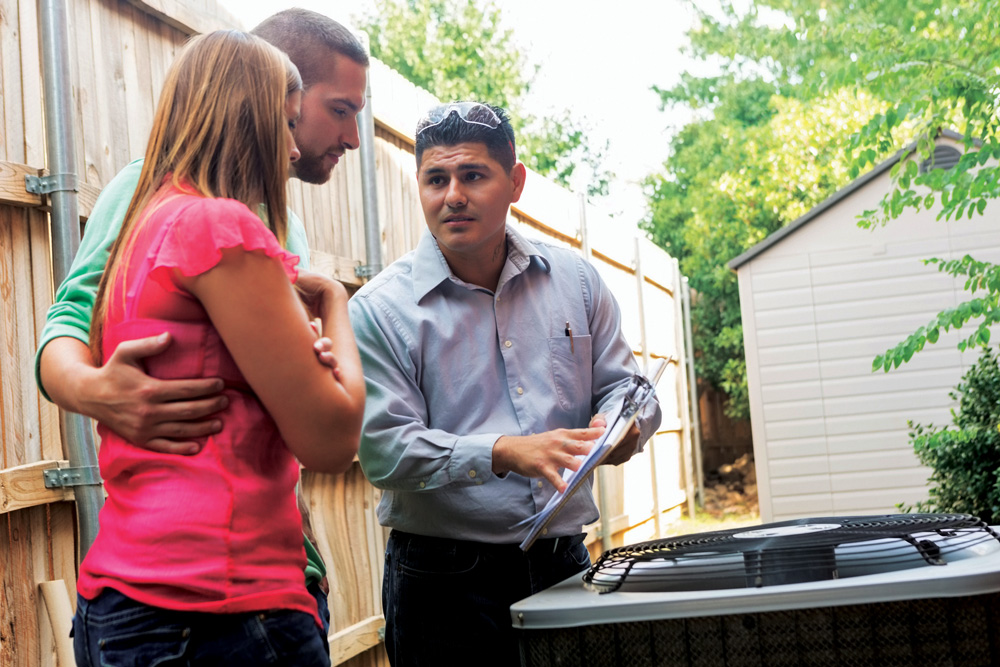 Before a homeowner goes to settlement on the purchase of a newly constructed home, you and the homebuyer should do a walk-through to conduct a final inspection. This walk-through will provide an opportunity to spot items which may need to be corrected or adjusted, educate the buyer about the way the new home works and what their responsibilities are, and answer any questions the homebuyer doesn't understand.
How Things Operate
When you buy a new appliance such as a washing machine, you usually have to read the instructions before you understand how to use all of the features. With a new house, the buyer will be overwhelmed with new appliances, systems, and maybe even ‘smart’ features. Not only will it help immensely if someone takes the time to show them how to operate all of these components and gadgets, but it shows that you care about the home and take pride in your finished craftmanship.
Maintenance Responsibilities
Part of your walk-through should be educating the buyer about maintenance and upkeep responsibilities. When you provide your buyers with a ten-year warranty, workmanship and materials are covered for one year. However, such warranties do not cover problems that develop because of failure to perform required maintenance. RWC/HOME of Texas provides a clearly written warranty booklet explaining what’s covered, what’s not covered, the responsibilities of new homeowners, and actions required citing specific guidelines and standards.
Builder Visits During the Year
Each builder is different, however, typically builders schedule two visits during the first year — one near the beginning and the other near the end — to make necessary adjustments and to perform work of a non-emergency nature. Explain to your client that you won’t be rushing out immediately for a problem such as a nail pop in your drywall. Such problems occur because of the natural settling of the house and are best addressed in one visit near the end of the first year.
Your Inspection Checklist
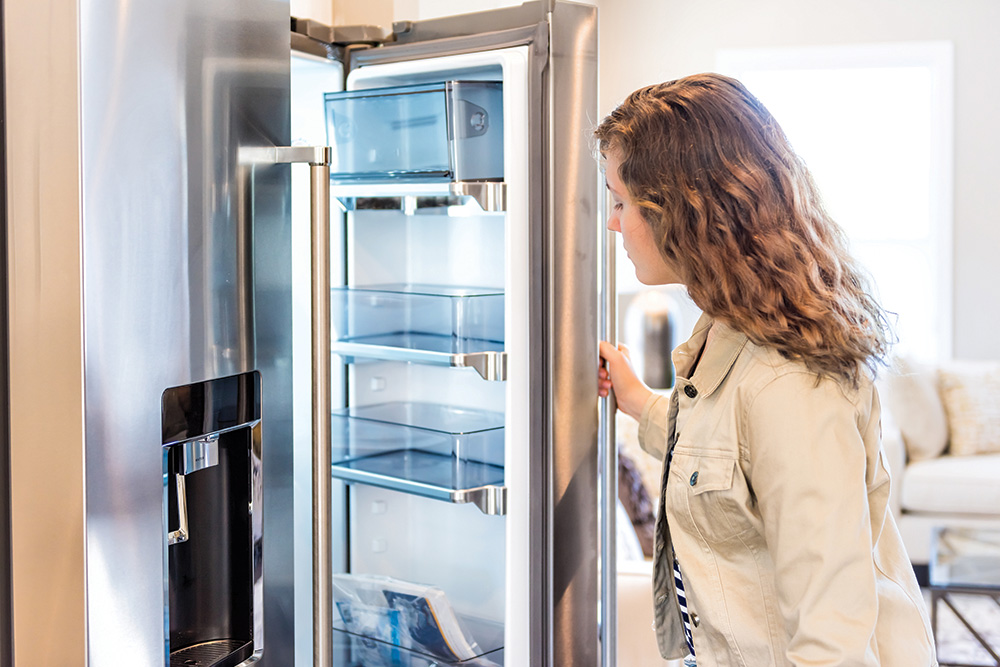 Creating a checklist when inspecting the house is key to organization and cognizance. The list should include everything that needs attention, and you and the homebuyer should agree to a timetable for repairs. Explain to the buyer that it’s best to remedy problems before they move in, because it is easier to work in an empty house. However, some items may have to be corrected after move-in. For instance, if the walk-through is in the winter, landscaping adjustments may be delayed until spring.
It is important to be thorough and observant. Examine all surfaces of counters, fixtures, floors and walls for possible damage. Sometimes disputes arise because a buyer may discover a gouge in a countertop after move-in, and there is no way to prove whether it was caused by the builder's workers or the buyer's movers. Many builders ask their buyers to sign a form at the walk-through stating that all surfaces have been inspected and that there is no damage other than what has been noted on the walk-through checklist.
In preparation for the walk-through and to ensure everything goes smoothly and efficiently, educate your homebuyers with these walk-through “Dos and Don’ts”.
DO
- Make a list in advance of any questions about maintenance/warranty procedures.
- Bring pens, paper, a clipboard, digital camera or phone to take notes and photos.
- Bring the purchase agreement, RWC/HOME sample warranty book, customer service manual, selection sheets, diagrams and landscape and pool plans, if applicable.
- Wear clothing that is appropriate for walking a construction site, including closed-toe shoes.
- Park in the street, not the driveway, especially if the home is still under construction.
- Verify the expected dates for completion of repairs, if any are needed, and get a copy of the completed punch list before you leave the site.
DON’T
- Be late for the walkthrough. Builders have busy schedules and may have appointments with other customers on the same day.
- Bring pets, children or other family members and friends. You’ll need to devote your full attention to what is being presented.
- Rush through the walkthrough. Take your time and be thorough.
- Be shy about asking a lot of questions.
On that note, the homebuyer will most likely ask a lot of questions during the walk-through and take notes on the answers. Be patient. This is the dream home they’ve been anxiously waiting to move into for months and they want to make sure everything is up to par and in perfect working order. It is important to view the walk-through as a positive learning experience that will enhance the enjoyment of your client’s new home for years to come. And furthermore, a genuine, caring and thorough home builder will get all the praise and kudos through word of mouth - the most powerful (and free) form of advertising!
www.nahb.org and www.newhomesource.com