
A new year is the perfect excuse to refresh more than just your routine. In 2026, why not make your home part of your New Year’s resolutions? Small, thoughtful upgrades can make a big difference in how your space feels—and how you feel living in it.
January: Build a home gym
Skip the commute and make workouts easier by turning an unused room into a simple home gym. A mirror, rubber flooring, a fan, and a TV for workout videos go a long way—and can save serious money on gym memberships.
February: Upgrade your windows
Cold months are ideal for replacing drafty windows. Energy-efficient options keep your home warmer, lower energy bills, and add resale value.
March: Declutter and spring clean
Less stuff = less stress. Tackle one room at a time, donate what you don’t use, and enjoy a cleaner, healthier, more productive home.
April: Add a three-season room
A sunroom or screened-in space gives you more room to relax and enjoy the outdoors—without committing to a full addition.
May: Organize home records
Gather warranties, manuals, and renovation receipts in one place. It’ll save time, money, and headaches later—especially if you sell. (And remember – your RWC warranty stays with your home, which is a notable selling point!)
June: Boost curb appeal
Fresh landscaping, new outdoor furniture, or even a garage door upgrade can instantly improve first impressions and home value.
July: Schedule a plumbing check-up
A quick inspection now can prevent costly surprises later. While you’re at it, test shut-off valves and check for leaks.
August: Go smart
Smart thermostats, doorbells, and security systems make everyday life easier—and appeal to future buyers.
September: Plan a remodel
Thinking kitchen or bath? Start planning early. Gather inspiration, get quotes, and talk to a local agent about what actually adds value.
October: Switch to LED lighting
LED bulbs use less energy, last longer, and can save you hundreds a year—an easy win as nights get longer.
November: Freshen up with paint
Paint is one of the cheapest ways to transform a space. Go neutral if you’re selling, or have fun with color if you’re staying put.
December: Reflect and reset
Take a moment to appreciate everything you improved this year. Staying on top of home maintenance really does pay off—and you’ve earned that celebration.
 Did you know that there is a specially designated number you should call before starting any digging projects? 811 is the (free) phone number you need to call before digging to protect yourself and others from unintentionally hitting underground utility lines.
There are millions of miles of buried utilities beneath the surface of the earth that we don't even think about but are vital to everyday living like water, electricity and natural gas. By simply calling, you'll help prevent unintended consequences such as injury to you or your family, damage to your property, utility service outages to the entire neighborhood and potential fines and repair costs.
Most contractors know that they need to find out what’s underground before beginning to break ground, but there may be some finer points of safe digging that you’re not aware of.
How exactly does this 811 thing work?
Simply call 811 from anywhere in the country a few days prior to digging, and your call will be routed to your local call center. Tell the operator where you're planning to dig. Your affected local utility companies will be notified about your intent to dig and will send locators to your dig site to mark the approximate location of buried lines with flags or paint.
When can I begin my digging project?
Wait for the marks! Utilities will mark their buried lines on your dig site. Most crews will arrive to mark your dig site with paint or flags within a few days and will make sure you know where to avoid digging so you don't hit buried utilities. Remember there may be multiple utility lines in the same area. Be sure to check your state laws for specific information. It's also a good idea to call and confirm that all affected utility operators have responded to your request and located accurately. (State laws vary on the process for confirmation; check with your local one-call center for more information.)
It's finally time!
Now it's time to roll up your sleeves and get to work - but respect the marks! Make sure to always dig carefully around the marks, not on them. State laws generally prohibit the use of mechanized equipment within 18-24 inches of a marked utility, which is called the “tolerance zone”. If you must dig near the marks, hand dig or use vacuum excavation to expose the facility. After exposing the facility, avoid using mechanized equipment within the same tolerance zone.
The marks provided by the affected utility operators are your guide for the duration of your project. If you are unable to maintain the marks during your project, or the project will continue past your request’s expiration date, please call 811 to ask for a re-mark. In addition, if excavation equipment is removed from a work site for more than two (2) business days, you must notify the call center again.
Also keep in mind that some utility lines may be buried at a shallow depth, and an unintended shovel thrust can bring you right back to square one - facing potentially dangerous and/or costly consequences. Don't forget that erosion or root structure growth may shift the locations of your utility lines, so remember to call again each time you are planning a digging job. Safe digging is no accident!
Source: call811.com and ccicomply.net
Sally wanted to buy a house in the valley, but she knew better than to dilly-dally. Sally had heard that houses were in big demand, so she hired a realtor to lend her a hand. The agent showed her three places, each of which offered beautiful spaces. She wanted to get into a house quick, however she could not decide what to pick. Her savvy agent was smart and knew just what wisdom to impart. For only one home came with sureties, it offered warranties to cover obscurities.

Whether you build homes, have a personal home to sell, or rehab homes to put on the market, you face similar obstacles. Buyers search for unique features and upgrades with the hope that one stands out above the rest. Trends can come and go, paint colors, flooring types, built-ins, all of these are at risk of becoming the next “no” on a buyers list. Something that does not go out of style, however, is the desire for reassurance and protection from defects or expensive repairs. Referencing the story of Sally above, let’s examine why an educated agent might recommend a house with warranty coverage.
Imagine how excited Sally was when she moved into her new home. To Sally, she saw a cute 5-year-old two-story bungalow with a private backyard near a babbling creek. The property included all the appliances and every updated feature that she had sought. At the time, it did not cross Sally’s mind that an issue may be awaiting her sooner rather than later. A few months after settling in, the water heater stopped working and she discovered a crack in the basement wall that appeared to be leaking.
Many buyers hope that these defects are caught by their chosen home inspector. However, even with the most detailed of inspections, appliances and mechanicals are fickle. These systems can break down without warning and inevitably at the worst moment. Adding to this scenario, because of limited inventory and high demand, waiving the buyers right to an inspection has become more common. This increases the chances of things being missed, like small cracks in the dark corner of a basement.
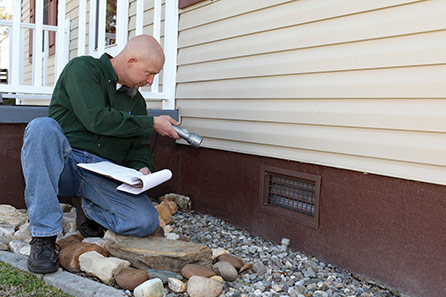
Without specific, clear, warranty protection in place, Sally has no assurances or proper assistance to help her with a resolution. All she is armed with is a concern that there may be a larger issue or potentially a known default that was not disclosed. A typical first step is to reach out to friends or neighbors who may offer suggestions and recommendations for who to contact. Based on similar scenarios that have occurred, things like this can go sideways very quickly.
For example, if a contractor determines that the leak is due to a structural failure that was imminent given the location to the creek, the original builder may find themselves in hot water. Since the home is only 5 years old, the problem may qualify as a pursuable default under statewide implied warranty statutes. Should it escalate, potentially, the builder may end up at the mercy of legal systems and public opinions. If the perspective viewpoints are not rooted in an understanding of typical building practices, endless court battles may ensue.
Additionally, mechanical warranties are a complex animal. It is not beyond feasibility that the fine print on the water heater may indicate that, without prior approval, the original owner cannot transfer the warranty. This disclaimer could allow the manufacturer to void the warranty. In either of these sample circumstances, Sally could present her complaints to an attorney and potentially be able to pursue legal recourse.
Let’s face it, in a sellers’ market, buyers are at a disadvantage, however disadvantage does not negate liability. Homeowners and well-meaning builders who believe their “good build history” should be enough are underestimating the overall risks. Without disclosing potential mechanical issues, sellers are left with the burden of proving no negligence existed. Without spelling out what sorts of structural things are covered and for what time frame, builders are inadvertently ignoring the potential for serious liability.

Warranties certainly are not the be all and end all to escape liability. What they can provide is peace of mind when navigating a homeowner's construction defect claim. The cycle of building, buying, and selling homes requires clearcut guidelines to help avoid fruitless and expensive legal battles. The appropriate coverage to meet these needs is vitally important to differentiate yourself, protect all parties, and demonstrate concern for the homeowner.
If you are unsure where to turn to get proper coverage, step one is to consult with a proven, stable, warranty company. With nearly 40 years of experience Residential Warranty Company, LLC, can help you determine what programs may work best to meet your needs. With an extensive list of options, including everything from new home construction to existing home coverages, there is something to suit every situation.
 Let’s talk about you. Do you build at least 20 homes per year? Or do you build at least $2 million in sales volume?
If you can answer yes to either question, have you considered joining our exclusive Incentive program?
The Incentive program is a great way for qualifying Members to effectively reduce their overall warranty costs by maintaining a high level of quality construction and customer service. Members receive “cash” back for a good claims record.
The idea behind the program is that if you have a good track record regarding claims issues for the 1st 5 years of your home enrollments, then the warranty company lets you “cash in” during the 2nd 5 years and earn back some of those premium dollars.
Both you and the warranty company chip in an initial minimum deposit to open up an Incentive account. Every time you enroll a home while in the Incentive program, the warranty company redirects a portion of the premium you’ve paid us into an account. As homes are enrolled, the fund grows. If you have a claim or hard-cost expenses (think Engineer’s structural inspection or geotechnical soils test) relating to a claim, we use this fund first – because those were insurance premium dollars that were being set aside rather than being paid to the insurer. If you don’t have a claim, the fund just keeps on growing.
Then beginning in year 6 and continuing through year 10, you start to receive checks back from us based solely on your own claims experience. It’s like betting on your own track record that you won’t have serious major structural defects in your homes.
If you have claims, you haven’t lost anything because you’ve paid the exact same rate that you were paying before joining the Incentive program. If you don’t have claims, you “cash in” and stand to get back up to 15% of your premium dollars.
After the first year, we’ll even waive your annual registration fee of $295 for every year that you participate in the program. That saves $1180 for your bottom line over the first 5 years even if you never get one penny back in distributions. It’s pretty much a win-win proposition.
So again I say, let’s talk about you. Can we help you cash in? Call us today at 800-247-1812, Ext 2149 for a free, no obligation illustration based on your company’s numbers and let’s see if we can help you benefit a little more from your good customer service.
 Ah, fall is the air. Are you ready for brilliantly colored leaves, pumpkin flavored treats, apple cider, or, ARE YOU READY FOR SOME FOOTBALL? George Will once said, “Football combines the worst two things about America: violence punctuated by committee meetings”. What that means is that for the next five months many Americans who tune in to NFL games will be watching a lot of TV but, in actuality, very little football. Several studies including one by the Wall Street Journal have calculated that although an NFL game lasts about 3 hours and 12 minutes there are only a mere 11 minutes of actual play time that takes place. Why is that? One big culprit is the rules. The paperback version of the NFL rulebook is close to 300 pages in length and filled with rules and regulations that address almost every possible scenario that could take place during a game. And while the rules may seem excessive and overbearing, they serve to ensure the uniformity, integrity, and safety of the game and its players.
Rules impact nearly every aspect of our lives. We can’t get away from them, nor should we. There are rules for governance, conduct, mathematics, grammar, driving, even cooking and the list goes on and on. It is fair to say that without rules there would be anarchy. Rules provide a society with structure and accountability. As a builder or manufacturer, you too are subject to a unique set of rules that address every aspect of your homebuilding from development through settlement. And, if the rules aren’t followed, there can be big problems. Without proper site preparation, foundations can fail. Without proper flashing, homes will leak. Without proper placement of beams, loads won’t be supported. Without proper spacing between joists, floors will sag. And this list too goes on and on.
The good news is that if you are an RWC, HOME of Texas and/or MHWC member builder, only the best of the best are accepted into their program…builders/manufacturers that follow the rules. Your homebuyers can be assured that you have met the company's high standards of quality workmanship, financial stability, and ethical customer dealings. And, then there’s the rulebook…The Limited Warranty Agreement. Your homeowners are given a set of rules, in writing, that explains what’s acceptable, what’s not and what steps to follow. What a great way to show them your integrity and how much you care about the product you deliver. Vince Lombardi once said, “Perfection is not attainable, but if we chase perfection, we can catch excellence”.
 A simple number can really give you perspective. Perhaps you were on the fence about doing more remodeling? Or are trying to brainstorm ideas for a fresh take on the homes you build? Consider these numbers and be inspired to try that new kitchen design or implement features in your homes for the aging population, for example. ...Or simple impress your colleagues with some fun industry facts!
3.5 PERCENT
Percentage of current housing stock that offers all three of these features to support independent living for an aging population: zero-step entrances, single-floor living, and wide halls and doorways.
1901 SQUARE FEET
Average U.S. home size, which is nearly 30% larger than European homes, but smaller than the Australian average of 2032 sq. ft.
$3.1 BILLION
Size of the kitchen and bath remodeling industry.
60 PERCENT
The percentage of contractors that said the number one way to drive up costs is when homeowners ask for changes after a project begins. These changes increase the cost by an average of 10 percent.
When most insurance agents hear the RWC Insurance Advantage offers Claims-made general liability coverage, they warn their general contractor customers to stay away from it. They say you’ll be trapped by the “gap” in coverage that will open up the moment you try to leave. What happens upon termination of coverage is one of the biggest arguments against Claims-made. The way some agents talk, you’d think Claims-made is like the old children’s poem “The Spider and the Fly;” “Will you walk into my parlor?’ said the Spider to the Fly.” We know the fly enters - never to leave. These agents argue there would be no coverage for any claim made after policy termination even if the loss occurred during the time the policy was in force. And they would be right – with any other company’s Claims-made policy. Those companies will offer you a Supplemental Extended Reporting Period, or SERP, at the end of your policy term when you try to move your coverage to another company. They will charge you up to 200% of your expiring policy’s premium for the SERP. Who can afford that and the new policy premium as well?
This WILL NOT HAPPEN with the RWC Insurance Advantage’s unique Claims-made policy. With our policy, the SERP is offered UP FRONT, and we GUARANTEE that it will be attached, as long as your policy is not canceled for non-payment of premium. Rather than charge a large lump sum at the end for the SERP, we add a reasonable 25% charge to each policy term, and you have 6 years to pay it off. After that, the SERP is fully funded and we GUARANTEE it’s attachment at policy termination - no matter what. Even better, if you decide to leave before the 6 years are up you’ll still get the SERP - and NO COVERAGE GAP.*
The SERP is unlimited in duration and can never be canceled for any reason. It automatically restores limits that may have been used up by prior claims. Even if you decide to move your general liability coverage somewhere else after just one year with the RWC Insurance Advantage, you’ll still get the SERP – guaranteed.
So, walk into our parlor anytime without fear of being trapped. Call us at (866) 454-2155 and ask for Ron Sweigert or click here for a free no obligation quote.
(*Subject to short rate premium penalty if you cancel your current policy before its expiration date.)
 As the economy continues to improve, builders are gaining more and more confidence in their business' future. Tides are shifting from builders only treading water to keep their company afloat, to moving forward and expanding profit margins.
The number one cost for builders is direct construction expenditures. Simply reducing costs, even modestly, and strategizing ahead of time will unmistakably help you reach your goals.
Check out the following suggestions and tips and implement them into your business plan to maximize your bottom line.
- Design your new models to attain a predetermined direct construction percentage rate based on the anticipated sales price. A model will not be acceptable if it exceeds a recommended percentage.
- Consider the cost of the lot to determine “how much” house you can build.
- Identify base-model features that can be replaced with more economical items without reducing the home’s appeal. Include input from subcontractors and suppliers about potential cost reductions including design alternatives and worker efficiency.
- Include all options and upgrades within each job’s budget.
- Determine the target gross profit as a component of the budget before starting a project.
- Avoid estimating by square footage. Unless the materials are identical, the site work known, and weather conditions constant, pricing by square foot often leads to inaccurate quotes and underpriced bids.
- Keep the specs simple. Too many options will limit the number of potential buyers.
- Re-estimate immediately after completing the first unit of a new plan to evaluate if additional costs should be considered for subsequent units.
- Create detailed direct construction budgets on model/display homes, just as you would with any other home. Display homes tend to evade the normal budgeting process, leading to higher costs and reduced profits when ultimately sold.
- Perform periodic walkthroughs to control costs and ensure materials are being used as intended. Project managers, superintendents, estimators, and designers should all participate in walkthroughs.
- Develop strong relationships with a select group of subcontractors and suppliers. Constantly switching subs and vendors in search of minor savings can be counterproductive. Try to work with your regular subs and vendors to find savings together.
- Schedule together with your key subs. This will result in a much more accurate schedule than if you created it yourself, and the subs will feel more responsibility to meet their milestones.
- Change orders should be documented using only written forms. This allows both you and the buyer to sign the change order, which should list the change, adjusted total price, and necessary schedule revisions.
- Don’t be afraid to raise prices, especially in a good market. As your costs increase, many of these should be reflected in the sales price. A regular price increase program should be in place.
Source: nahb.com
Why is it important to worry about safety when it comes to wet concrete? Because concrete is one of the most widely used construction materials there is, which means there are an untold number of workers who are exposed to these hazards on a daily basis. The biggest hazards include skin irritation, severe chemical burns, and serious eye irritation. Concrete can be safe when used appropriately and with the safety precautions below.
- Wet cement (an ingredient in concrete) is caustic, abrasive and drying, so protect your skin. Wear appropriate PPE such as tall rubber boots, pants, waterproof gloves and long-sleeved shirts.
- If concrete comes into contact with your skin, it’s important to immediately wash off with clean water and replace any wet clothing or PPE. Don’t wait!
- Be sure to wear eye protection when working with wet concrete. Your eyes can be seriously injured due to splashing concrete. Wear safety glasses with side shields or safety goggles.
- Wet concrete can conduct electricity. All electric tools should be grounded and used with care.
- When raising or lowering concrete chutes, be aware of pinch points. These can take off a finger or hand if you’re not paying attention.
- Protect your back. Place wet concrete via chute, wheelbarrow or pump, as close to the work area as possible. Concrete should be pushed, not lifted, into place.
- Use waterproof kneepads or a dry board when kneeling to place or finish concrete.
It’s important to understand that you may not experience any acute symptoms right away if wet concrete touches your skin. But if you don’t wash the area as soon as possible with cold, clean water, you could end up with a serious burn. If a burning sensation continues or worsens even after you’ve flushed the area with water, seek medical attention. If wet concrete splashes into your eyes, flush them continuously with clean water for at least 15 minutes and then go to the hospital.
Source: www.ccicomply.net
Occasionally we will highlight a section of the warranty book just as a reminder of how things work or to demonstrate protections built into the warranties. This time, we thought a reminder of all the various warranty options available to you by virtue of your RWC membership might be helpful.
Let’s start off here: http://www.rwcwarranty.com/builders/whats-covered/. As an RWC Member, you have choices galore!
You can have a warranty with Major Structural Defect coverage or a warranty with coverage on Designated Structural Elements. You can have coverage that includes workmanship, materials, mechanical systems and structural components or you can pare it down to one that just covers structural components. You can stick to the traditional FHA/VA approved 10-year variety or customize it with a warranty that mirrors your state’s statutes.
That covers the “new home” variety of warranties. But we know that many builders out there do much more that build new homes. They remodel, they convert commercial structures into condos, they may build a detached garage and on and on.
That being said, check out the RWC Menu of Choices at rwclive.wpengine.com/builders/warranty-options/
- RemodelerWarranties with options to fit the job (and in states like Indiana & Minnesota, to meet state statutes as well)Commercial Warranties
- Conversion Warranties
- Building Systems Warranties
- HUD-Code Manufactured Home Warranties
- Appliance & Systems Extended Warranties*
- 1 Year Renewable Warranties
- Commercial Insurance Products (GL, Builder’s Risk, and Contractor’s Equipment)
*Available in select states only at this time.
We’re working hard to meet the needs of our Membership. If you have a need for a warranty and we don’t have a product to meet that need, let us know and we’ll look into it. We’re always on the lookout for ways to better serve our Members!