
Homebuyers continue to place a premium on outdoor living spaces that extend the comfort and functionality of the home beyond its walls. From expansive composite decks and custom patios to fully equipped outdoor kitchens, these features have become key selling points in today’s new construction market. For builders, outdoor living spaces offer an opportunity to differentiate projects, increase home value, and meet evolving buyer expectations. As these spaces become more sophisticated, however, builders must also consider quality construction practices, material performance, and long-term durability to ensure homeowner satisfaction.
Custom Decks: Combining Style and Performance
Today’s deck designs are larger, more customized, and built to serve multiple purposes. Popular trends include:
- Multi-level deck configurations that create dedicated spaces for dining, entertaining, and relaxation.
- Composite decking materials that offer durability and reduced maintenance requirements.
- Integrated lighting systems that improve safety and enhance ambiance.
- Built-in seating, privacy screens, and fire features that add functionality and visual appeal.
As deck designs become more complex, proper installation, drainage considerations, and structural integrity remain critical to long-term performance.
Patios Designed for Year-Round Enjoyment
- Modern patios are evolving into outdoor living rooms that homeowners can enjoy throughout multiple seasons. Current trends include:
- Large-format pavers and decorative concrete finishes.
- Covered patios and pergolas that provide shade and weather protection.
- Outdoor fireplaces and fire pits that extend usability during cooler months.
- Thoughtfully designed landscaping that creates privacy and complements the home’s architecture.
- Built-in grills and cooking stations.
- Refrigeration and beverage centers.
- Durable stone countertops and weather-resistant cabinetry.
- Entertainment systems and bar seating areas.
Because outdoor kitchens incorporate multiple building components, including plumbing, electrical systems, and appliances, careful planning and coordination among trades are essential to ensure quality installation and long-term reliability.
Creating a Seamless Indoor-Outdoor Experience
One of the most influential trends in residential construction is the desire for a seamless transition between indoor and outdoor spaces. There are a variety of methods used to accomplish this. You can install expansive sliding and folding glass door systems, and pair that with open-concept floor plans that flow naturally to outdoor living areas. Consistent design elements can be utilized to connect interior and exterior spaces. And a modern touch would be to include integrated smart-home technology that extends into outdoor environments. These design choices not only enhance the homeowner experience but can also increase perceived living space and overall home value.
Quality Construction Matters Beyond the Closing Date
As outdoor living spaces become more elaborate, homeowners expect these investments to perform as beautifully as they look. Proper installation practices, quality materials, and attention to detail play an important role in reducing callbacks and supporting homeowner confidence. Builders who focus on craftsmanship and long-term durability help protect both their reputation and the homeowner’s investment.
Supporting Builders Through Every Stage of Homeownership
Outdoor living spaces are helping shape the future of residential construction, offering homeowners more ways to enjoy their homes while creating new opportunities for builders to stand out in the marketplace.
As buyer expectations continue to evolve, builders benefit from partners who understand the importance of quality construction and homeowner satisfaction. A comprehensive home warranty program, like the many options offered by RWC and affiliates, can provide added peace of mind by helping protect homeowners after closing while reinforcing a builder’s commitment to delivering lasting value.
The result is more than a beautiful outdoor oasis—it’s a home built to inspire confidence for years to come.
Home buyers are no longer looking only for square footage and finishes — they want homes that are comfortable, energy-efficient, durable, and built for the future. For builders, that shift creates a major opportunity. Advances in insulation, HVAC technology, and sustainable materials are making it easier than ever to construct high-performance homes that reduce operating costs while increasing long-term value.
High-Performance Insulation Raises the Standard
Modern insulation systems are doing far more than meeting code minimums. High-performance options such as spray foam, rigid exterior insulation, insulated concrete forms (ICFs), and advanced mineral wool products help create tighter building envelopes that minimize heat loss and air leakage. The result is improved indoor comfort, lower utility bills, better moisture control, and reduced strain on HVAC systems. Builders investing in superior insulation strategies are also finding it easier to meet stricter energy codes and green certification requirements.
Heat Pumps Are Becoming the Preferred HVAC Solution
Heat pump technology has evolved rapidly in recent years, making all-electric heating and cooling practical even in colder climates. Today’s air-source and ground-source heat pumps offer impressive efficiency, quieter operation, and lower emissions compared to traditional furnaces and air conditioners. For builders, heat pumps provide several advantages:
- Reduced energy consumption
- Simplified mechanical systems
- Compatibility with solar energy
- Increased appeal to energy-conscious buyers
As electrification trends continue and utility incentives expand, heat pumps are expected to become a standard feature in many new residential developments.
Net-Zero Homes Are Moving Into the Mainstream
Net-zero homes — properties designed to produce as much energy as they consume annually — are no longer niche projects. Improvements in building science, renewable energy systems, and smart home technology are making net-zero construction increasingly attainable. A typical net-zero strategy combines:
- Airtight construction
- High-performance windows and insulation
- Efficient HVAC and water heating systems
- Solar photovoltaic systems
- Smart energy monitoring
Builders who adopt net-zero principles now position themselves ahead of future code changes while appealing to buyers seeking long-term energy savings and environmental responsibility.
Sustainable Materials Are Reshaping Construction
Innovation in eco-friendly building materials is accelerating across the industry. Today’s sustainable products are not only environmentally responsible; many also outperform conventional materials in durability and maintenance. Popular options include:
- Engineered wood products that reduce waste
- Recycled steel framing
- Low-carbon concrete alternatives
- Bamboo flooring and paneling
- Reclaimed wood finishes
- Composite decking made from recycled plastics
These materials help reduce environmental impact while offering strength, longevity, and modern design flexibility.
Durability Is the New Sustainability
Sustainability is no longer measured solely by recycled content. Long-lasting, low-maintenance materials contribute significantly to environmental performance by reducing repair cycles, replacement waste, and lifecycle costs. Builders who prioritize durability alongside efficiency can deliver homes that maintain value, perform better over time, and require fewer resources throughout their lifespan.
Building for the Next Generation
Energy efficiency and sustainable construction are rapidly becoming expectations rather than upgrades. Home builders who embrace high-performance insulation, heat pump technology, net-zero strategies, and innovative materials will be better positioned to meet changing buyer demands and evolving regulations. The future of residential construction belongs to homes that are smarter, healthier, more resilient, and built with long-term performance in mind.
Check out building/warranty/industry news, RWC announcements, upcoming events, etc.
When you buy a home—especially a newly built one—you’re not just investing in a place to live, but in long-term peace of mind. Two key protections often come into play: new home warranties and homeowners insurance. While they’re sometimes used interchangeably in conversation, they actually serve very different but complementary roles.
Educating your buyers on how each works can help them feel more confident in the coverage you are providing vs what they get with their insurance company, and therefore, be better prepared for the unexpected.
Two Types of Protection, Two Different Purposes
It helps to think of homeowners insurance and new home warranties as addressing different kinds of “what if” scenarios. Homeowners insurance focuses on sudden, accidental events—things like storms, fires, or theft. New home warranties focus on how the home was built, covering certain defects in materials or workmanship that may surface over time. Both are valuable, and together they provide a more complete safety net for homeowners.
What Homeowners Insurance Typically Covers
A standard homeowners insurance policy is designed to protect your home and belongings from unexpected damage or loss. Common coverage includes:
- Fire and smoke damage
- Weather-related events like wind, hail, or lightning
- Theft or vandalism
- Certain types of water damage (such as a burst pipe)
- Personal liability protection
Example: If a strong storm causes a tree to fall and damage your roof, your homeowners insurance would typically cover the repairs (subject to your deductible and policy terms). However, insurance is not intended to cover everything. It generally doesn’t apply to gradual issues, routine wear and tear, or concerns related to how the home was originally constructed.
What a New Home Warranty Covers
A new home warranty, provided by you, the builder, offers coverage for specific aspects of a home’s construction. Coverage and terms may vary depending which variety you choose, but using a standard 1-2-10 warranty as an example, they are usually structured in phases:
- Year 1: Coverage for workmanship and materials (e.g., drywall, trim, finishes)
- Years 1–2: Coverage for major systems like plumbing, electrical, and HVAC
- Up to 10 years: Structural coverage for key load-bearing components
Example: If you notice that a door isn’t closing properly due to settling or that tile was not installed as expected, those types of concerns may fall under your warranty coverage rather than insurance.
Why Structural Warranty Coverage Matters
One of the most important components of a new home warranty is the structural coverage. This portion focuses on the core elements that support the home, such as: foundation, framing, load-bearing walls, and roof structure, just to name a few. These elements are essential to the home’s stability and long-term performance.
A Closer Look
While modern construction follows strict standards and inspections, homes are complex structures built from many materials and systems working together. Occasionally, underlying issues can emerge over time. Structural repairs, when needed, can be significant in scope and cost. Addressing foundation movement or framing concerns, for example, may involve specialized work that goes well beyond typical home maintenance.
It’s also important to note that homeowners insurance is not designed to cover structural concerns related to construction or long-term settling. That’s why structural warranty coverage plays such a valuable role—it helps bridge that gap.
How Warranties and Insurance Work Together
Rather than overlapping, these protections complement each other. Insurance helps with sudden, external events while a warranty helps with certain construction-related concerns.
Side-by-Side Example:
A pipe bursts due to freezing temperatures → Insurance may cover the damage. If a pipe develops a leak due to an installation issue → Warranty may address the repair
Having both in place means you’re better protected across a wider range of situations.
Tips for Home Buyers and Homeowners
If you’re purchasing a newly built home, consider these tips:
- Review the details of your builder’s warranty, including what’s covered, what's not, and the warranty term.
- Understand how to submit a claim if an issue arises.
- Ask whether the warranty is transferable if you sell your home.
- Maintain a comprehensive homeowners insurance policy and review it annually.
What It All Comes Down To
A new home is an exciting milestone, and today’s homes are built with care, expertise, and evolving standards. Even so, having the right protections in place adds an extra layer of reassurance.
And since homeowners insurance and new home warranties each play a distinct role, understanding how each works isn’t just helpful—it’s a smart step toward protecting your home for years to come.
By Victoria Sontheimer, RWC
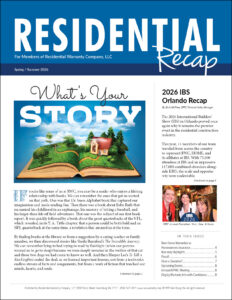
If you’re like some of us at RWC, you may be a reader who enjoys a lifelong relationship with books. We can remember the ones that got us started on that path. One was that Dr. Suess Alphabet book that captured our imagination and made reading fun. Then there was a book about Babe Ruth that recounted his childhood in an orphanage, his mastery of hitting a baseball, and his larger-than-life off field adventures. That one was the subject of our first book report. It was quickly followed by a book about the great quarterbacks of the NFL, which revealed, in its Y. A. Tittle chapter, that a person could be both bald and an NFL quarterback at the same time, a revelation that amazed us at the time.
By finding books at the library or from a suggestion by a caring teacher or family member, we then discovered stories like Sheila Burnford’s The Incredible Journey. We can remember lying in bed trying to read by flashlight (when our parents wanted us to go to sleep) because we were deeply invested in the welfare of that cat and those two dogs we had come to know so well. And then Harper Lee’s To Kill a Mockingbird sealed the deal, as we learned important lessons, not from a textbook’s endless stream of facts and assignments, but from a work of fiction that touched our minds, hearts, and souls.
Since then, we’ve read hundreds of books that entertained, educated, or captivated us all the way to their thrilling, meaningful, or startling endings. Over time, we also began many other books that we simply couldn’t finish. There are a few reasons why we keep reading books to the end and remember some books all our lives and why we forget the many that we toss aside without finishing.
First, a good author keeps us turning the pages so that the end of each chapter leaves us thirsting for the story to continue. Another is the skill of the author in creating interesting characters who we care about and thought-provoking circumstances in which we can imagine ourselves—in other words a product of such good quality that we simply must have it. Then there is the hook that captures our imagination and makes us want to know whether that cat and those dogs make it home or whether Atticus Finch can get Tom Robinson the justice he deserves.
As builders, we can learn a lot from the books we’ve loved. For example, when a customer sees your billboard or online ad, does he want to turn the page and visit your office or model home, or does he throw that experience on the pile of ads that were easy to ignore or never really grabbed his attention in the first place? Once in your office or model home, what does he think about the quality of the product you want to sell him? Can he picture the happy ending that comes from living out the thousands of pages and hundreds of chapters of his life in the home you will build him, or does he lose interest because nothing you have to offer stands out from the crowd? When he drives into your development, does he think, “Wow, this must be a great place to live,” or does he turn around after a block or two to look for a place that gets his juices flowing?
And don’t forget that hook that draws a reader into a world he wants to experience or, in our case, captivates a potential home buyer. What is your hook? Is it quality of craftsmanship or value? Is it affordability or design? Is it small low maintenance lots or big yards where the kids can play? Or is it some combination of these qualities? If you find the right hook, you’ll be better able to reel those customers in and grow the kind of company you have always dreamed of having.
What’s your story? Is it a well-crafted one whose hook keeps bringing you customers? We hope it’s a page turner that tells your customers and prospective customers that time spent with you will be something they will always remember and give them an experience that positively changes their lives forever.
Speaking of books, there is no better book you can give your customers at contract time than a warranty from Residential Warranty Company. Over more than four decades, RWC has provided warranty protection on over four million homes. We offer a wide variety of warranty options like our standard ten-year warranty, our Day 1 coverage warranty, our extended appliance and systems warranties, and our specialty warranties for remodeling projects, detached garages, and commercial construction. Only RWC has developed and offers its members a customized state warranty that mirrors each state’s statute of repose and accommodates other state specific issues. All RWC warranties provide clear performance standards that help create realistic homeowner expectations and provide a road map to resolve even the stickiest customer complaints.
At RWC, every guarantee our warranties make is backed by Western Pacific Mutual Insurance Company, RRG. Western Pacific has an A- rating from A. M. Best and only insures home warranty and similar new home construction risks, like builders’ general liability, which can be offered through the RWC Insurance Advantage program to RWC members. No other warranty company has an insurer with this kind of strength solely dedicated to covering builders and their homes.
Each person or company is the author of their own destiny. Here’s hoping that yours is a bright and successful one and that, with RWC at your side, your homes are best sellers!
Have a great summer!
In the little towns where we grew up, homeowners, like our parents, knew the people to hire if their home needed repairs or modifications. There was Mr. Allen for sidewalks and other flat work. Mr. Teufel was the man to call if you were replacing wallpaper, especially if the work was needed in your foyer or living room. The Wilson brothers were best for roofs, and if a ball had been thrown through a window, they would hire Mr. White, if they could get him. Often the deciding factor on whether to retain any of these gentlemen was not dependent on price, but on how soon they could come and do the work. They were all in demand because they were known to be craftsmen whose work was usually worth the wait.
Another such craftsman we were lucky to know personally was the carpenter, Mr. Nonemaker, or as we knew him, our great uncle Bill. He was a master cabinet maker who could remodel kitchens and fix anything, but more impressively to us at the time, could convert any dark or creepy basement that did not have a dirt floor into a rec room where countless hours of pool or ping pong would be played. For livelier and more well-heeled customers, he would add a bar, and perhaps a powder room. He was careful and methodical in his work and liked to fish a lot (and drink a bit), so sometimes his projects would take a while to complete. But he was worth waiting for. He loved when customers would tell him that friends and neighbors who were invited for the first time to the rec room or remodeled kitchen would run their hands along cabinets, drawers and seams before asking, “This is Mr. Nonemaker’s work, isn’t it?”
Times have changed, of course, with the big box hardware stores dotting the landscape and DIY “experts” populating You Tube with How-To videos. And that’s a shame because, while people might be getting their home repairs done more quickly and on their own time and money terms, they do not get to appreciate the product that was delivered by the Mr. Whites, the Wilson brothers, or the Uncle Bills we remember from just a few decades ago. Richard Sennett, the renowned American sociologist who studies work in modern culture, distinguishes mere work from craftsmanship and describes craftsmanship as “the desire to do a job well for its own sake.” White, the Wilsons, and Uncle Bill were not mere workers. They were craftsmen who took pride in their work, as if it were an art form.
With building supply prices near all-time highs and with pressure from buyers pushing housing prices downward, builders face pressure to keep their costs down. But just as it was decades ago, people will pay for quality and for a home they can take pride in, and nothing makes a homeowner prouder of his home than when people notice the craftsmanship that went into building it. A good way to distinguish your company from your competitors is to insist that your employees and subcontractors who are in the trades not just build to code but build with a level of craftsmanship that gets noticed and is appreciated by your customers and prospective customers.
You may think this suggestion is crazy given the reported shortage of skilled home building labor. This shortage is well documented in a study released by the Home Builders Institute earlier this year. According to the HBI, the aggregate economic impact from longer construction times associated with the skilled labor shortage costs the industry an estimated $10.6 Billion each year. The shortage also results in a reduction of nearly 20,000 homes built per year and an average increase in construction time of about two months per home built. In light of these findings, the NAHB and the HBI are supporting hands-on training programs and industry-recognized certifications to help produce a new generation of skilled laborers.
Recognition of this problem and an industry-wide effort to address it could not come soon enough. Here at RWC, for the first time in forty years, we have noticed an uptick in workmanship claims dating back to the Covid pandemic. Some builders in some parts of the country seem to have trouble finding subcontractors and skilled laborers who have and demonstrate the pride of a craftsman in their work. We believe each of our members, following the lead of the NAHB, can either rid themselves of this problem or make sure they don’t experience the problem in the first place in the following ways.
First, find young people (male and female) who are looking for a rewarding career that gives them the opportunity to do something they can be proud of. Start with vocational schools or check your local high schools for career pathway programs that team with employers to give students shadowing and interning opportunities. Throughout the process of exposing students to your operations, plant the seed early that your company is a place for craftsmen, that working there will be different from working other places, and that you want your whole team to take pride in what they do. If the articles we read about the expected growth of Artificial Intelligence can be believed, there will be many fewer entry-level white-collar jobs available to young people over the next decade. Get your recruitment plan ready now and grow that next generation of craftsmen from what may be an expanded pool of candidates.
Second, train your new employees and subs not just to build to municipal code standards, but to build to your company’s standards. Set that bar high enough that people, after seeing the high level of craftmanship in any of your homes, will turn to the owner and ask, “This is (Your Company’s) work, isn’t it.”
Third, if all goes according to plan, your skilled workers will improve your company’s reputation, increase sales, and even allow you to charge more for your homes. Share your good fortune with them. Pay them what they deserve, like craftsmen, who “do a job well for its own sake,” and thus keep them building for you and not for your competitor.
We believe that if you follow this plan, you will become even prouder of the homes you build, and you’ll sell more of them. And when you do, make sure that each and every one of your homes are covered by an RWC new home warranty.
Over more than forty years, RWC has provided warranty protection on over four million homes. We offer a wide variety of warranty options like our standard ten-year warranty, our Day 1 coverage warranty, our extended appliance and system warranties, and our specialty warranties for remodeling projects, detached garages, and commercial construction. Only RWC has developed and offers its members a customized state warranty that mirrors each state’s statute of repose and accommodates other state specific issues. All RWC warranties provide clear performance standards that help create realistic homeowner expectations and provide a road map to resolve even the stickiest customer complaints.
At RWC, every guarantee our warranties make is backed by Western Pacific Mutual Insurance Company, RRG. Western Pacific has an A- rating from A. M. Best and only insures home warranty and similar new home construction risks, like builders’ general liability, which can be offered through the RWC Insurance Advantage program to RWC members. No other warranty company has an insurer with this kind of strength solely dedicated to covering builders and their homes.
Like the skilled craftsmen you know, we at RWC take pride in our work and try to do every job well, just for the sake of doing it well. Help us put that attitude to work for you by placing an RWC warranty on every home you build.
Have a great fall & winter!