
 The 2023 National Sales Meeting, held in Harrisburg, PA, October 24-26, brought forth a blend of emotions as we welcomed new faces, felt the absence of some big personalities, and embarked on a journey to accomplish some major achievements.
At the 11th hour we got the unfortunate news that we would be without fellow colleagues Fred Taylor and Jana Watts for the weeklong rally. They were sorely missed personally and professionally, as two of our most prolific and confident “conversation starters.” Some new faces included Crystal Jackson from the Midwest, Tiaira Satchell covering the northern mid-Atlantic region, and Logan Canby as our new New Jersey Account Executive.
The other elephant in the room was the absence of our long-time leader and recent retiree, Sue Palkovic. Sue’s fingerprints were all over this meeting as most of the leg work putting it together came from her and Assistant Manager, Jody Lehman. Many thanks to both for shaping it up.
The first day of the meeting kicked off with 30 minutes of where we came from, where we are now, and where we’re going with President/Owner, George Parmer. Richard Swartz, Executive VP and Chief Counsel was up next to share his words of wisdom and encouragement. Additional managers who delivered presentations and lead brainstorming sessions included those from the IT Department, Insurance, and Marketing.
We also formally announced the results of our annual sales competition with Staci Cool taking first place and Fred Taylor grabbing second. Additional certificates of merit were awarded as well.
The 2nd annual Round Robin Session took place the next day at the corporate office. Account Executives were teamed up and conducted visits to the Membership, Enrollments, and Warranty Resolution Departments to gain insights into current developments and to refresh their knowledge of daily operations. The third and final morning started off with discussions of our Key Estates Extended Warranty Product. The afternoon allowed management to rejoin the sales team for a comprehensive review of the Round Robin sessions. The conversation proved to be productive and forward thinking. Such opportunities for the Account Executives to interact and brainstorm with the staff at the corporate headquarters are priceless. It creates a chemistry and camaraderie that is enviably portrayed in our business practices with our members and their homeowners.
Ambition was high heading into the meeting. We’ve put a lot on our plate for 2024. There’s one way to get there. In the words of Rich Swartz (quoting his track and field coach) - “Run as hard as you can for as long as you can.” and that's exactly what we plan to do.
 After decades of dedicated service and unwavering commitment, VP of Sales, Suzanne Palkovic, bid farewell to RWC & Affiliates this summer as she embarks on a well-deserved retirement.
Sue began her career at RWC in October 1987 as our Pennsylvania sales representative after a short stint selling life insurance for another company. Her devotion to her job, her coworkers and the company led then Vice President of Sales Lynn Nelson-Probst to promote Sue to Assistant Sales Manager in 1994.
By virtue of her imagination and ability to see projects through to the end, Sue was promoted to Director of Research and Development in 2001, and in 2003 she was named Vice President of Marketing, Research and Development. After Lynn Nelson Probst retired, Sue became our Vice President of Sales in June of 2015, the position she held until her retirement. During her last eight years with the company, she managed our entire sales force and was a constant proponent of superior customer service for our builder members. Sue was a tireless worker for our company. Her strong leadership and keen understanding of the warranty marketplace contributed greatly to our companies’ success. We will miss her wit, her wisdom, her tenacity, and her dedication.
Sue is succeeded by our new National Sales Manager, Rich McPhee. Rich is new to the position, but not to the company, having served as a highly successful sales representative in the mid-Atlantic states for the last ten years. Sue had an opportunity to mentor Rich, and we are happy to report that he has hit the ground running.
Sue plans to travel, spend time with her family, and become more active supporting causes that are near and dear to her heart. She leaves RWC with our good wishes for a long, happy and healthy retirement and with heartfelt gratitude for many years of loyal service.
Check out building / warranty / industry news, RWC announcements, upcoming events, etc.
 Optimism. It was a favorite theme of our parents when they told us to hold our heads high and keep our chins up. We heard it from coaches and teachers who suggested that we should look on the bright side of things. “Count your blessings” is advice often heard from friends and counselors. Optimism is a recurring element in books, movies, and music. If we try hard enough, we can almost hear Louis Armstrong urging us to “Grab your coat, grab your hat, leave your worries on the doorstep. Just direct your feet to the sunny side of the street.”
Optimism has been described as hopefulness and confidence about the future or about the successful outcome of something. Most of us have lived long enough to know that an optimistic path filled with hope feels much better than a pessimistic one characterized by a sense of dread or despair. Medical and psychological research suggests that there are tangible and even provable positive effects when we live our lives optimistically.
Optimists feel healthier. If we tend to believe that life will work out in our favor, we are more likely to rate our sense of well-being and health higher. Optimists have a lower incidence of cardiovascular disease and better cholesterol numbers and are generally healthier. Optimists live longer, and their immune systems are stronger. They tend to have better relationships with others, they enjoy their work more, and they are less prone to stress.
Being an optimist makes emotional, medical, and psychological sense. Sometimes, however, troubling circumstances can make even the most happy-go-lucky person worry, and doubt can creep in causing us to become, well, pessimistic. In these days of the twenty-four-hour news cycle and with the explosion of social media, it seems that, everywhere you look, someone is dying to tell you how bad things are and how worse they are going to get.
This constant drumbeat of negativity can affect people in all walks of life, and builders are not immune from the stories that affect us all. Some stories, however, hit closer to home with builders. Labor shortages and supply chain problems have lingered after the pandemic and still have not been resolved. War in Europe has spooked financial markets and wreaked havoc on the price of oil. Inflation and the resultant hike in interest rates have made some homebuyers skittish and have driven some out of the market altogether.
When we think about these circumstances, we could hang our heads or mope around. But it is important, even in times like these, to be optimistic and to consider the words of Benjamin Franklin who wrote, “While we may not be able to control all that happens to us, we can control what happens inside us.” That is, we can choose to keep our chins up, count our blessings and look on the bright side of things. We control what happens inside us by staying optimistic, and in that way, we continue to enjoy life and reap the benefits that optimism brings.
Not letting these kinds of problems affect our mood or our outlook on life is healthy, but thinking positively about the future will not make the problems go away. What is an optimist to do in these circumstances? The great British statesman Winston Churchill answered this question when he wrote: “The pessimist sees difficulty in every opportunity. The optimist sees opportunity in every difficulty.”
Rather than wringing his hands over a tough economy, the optimist looks for whatever opportunities these difficult times present. If we are not as busy building houses, we can identify our best workers and subcontractors and do those things necessary to keep them in the fold. We can also cull those who are problematic, who are not team players, or who do not fit into our long-term plans. We can analyze the market and check to see if the designs we offer our customers are consistent with current trends. We can sharpen our pencils and decrease expenses by finding the best value in building supplies and by looking for more efficient ways to build our homes. By seeing these opportunities in our present difficulties, the optimistic builder can make his company stronger and come roaring out of these doldrums at the helm of a better and more profitable company.
Making money from the work that goes into creating a business and running it well is good, but keeping those hard-earned dollars is even better. We believe one of the best ways for you to protect your bottom line and to hold on to more of your profits is to place an RWC warranty on every home you sell. After closing on a home, you can get on with building the next one, confident that your homebuyers are in good hands and that any construction defect claims they have will be handled with the utmost care and professionalism.
In our more than four decades of home warranty experience, RWC has covered more than four million homes. We offer a wide variety of warranty options, like our standard ten-year warranty, our Day 1 coverage warranty, our extended appliance and system warranties, and our specialty warranties for remodeling projects, detached garages, and commercial construction. Only RWC has developed and offers its members a customized state warranty that mirrors each state’s statute of repose and accommodates other state-specific issues. All RWC warranties provide clear performance standards that help create realistic homeowner expectations and provide a road map to resolving even the stickiest customer complaints.
At RWC, every guarantee our warranties make is backed by Western Pacific Mutual Insurance Company, RRG. Western Pacific has an A- rating from A.M. Best and only insures home warranty and similar new home construction risks, like builders’ general liability, which can be offered through the RWC Insurance Advantage program to RWC members. No other warranty company has an insurer with this kind of strength solely dedicated to covering builders and their homes.
We are optimists here at RWC, and we know life is better on the bright side. Here’s hoping your homeowners and you join us there!
Have a great Summer!
The past two years of supply-chain disruptions, compounded by labor shortages, have forced builders to improvise, adapt and overcome. Throughout these still-challenging times, builders have come up with creative and viable solutions to properly complete homes when the critical path becomes the path less followed. Here are some examples.

1. Window Flashing. To keep projects moving when the windows are nowhere in sight, leave the house wrap stretched over their rough openings, which will help to protect the interior until windows arrive.
2. Structural Elements. Structural sheathing can be interchanged with other more readily available options, but work with your architect or engineer to ensure compliance with the building’s requirements. It’s also important to understand how differences in vapor permeability among sheathing materials affect wall performance. Be aware of and stay close to the wall vapor profile that’s recommended for your climate.
3. House wraps. House wraps vary significantly in permeability ratings and in their ability to function as an air barrier. Do your homework, and be aware of your climate conditions.
4. Insulation. While wall cavity insulation products can be interchanged, they vary significantly in their thermal (R-value) ratings and impact on a wall’s vapor profile. Fiberglass batts and loose-fill products can be used in any climate, but damp-sprayed cellulose isn’t recommended for hot/humid areas. Closed-cell spray foam insulation can be used in any climate and also provides an excellent air barrier.
5. Tile Backers. There are two primary types of wet-area tile backer: those that are surface, and those recommended to be installed over a water-resistant barrier or made to be waterproof on the surface. There’s also a class of waterproof membrane that provide a fully waterproof membrane over a variety of backers that are adequately secured to the framing to bear the weight of the tile. The critical point is to avoid simply swapping out tile backer products without knowing what’s required to make them waterproof.
Before you try alternatives to these critical material specs, perform your due diligence on the differences in their performance, and confer with your architect, engineer and especially your trade partners.
Source: nahb.org
No one would argue that a home is likely one of – if not the – biggest purchases you will ever make in your life. And while doubts associated with such a transaction are to be expected, incidents of buyer’s remorse seem elevated in the midst of the previous year’s wildly fluctuating market. 2022 was a tale of two extremes, and each was a trigger causing people to question their home-buying decisions for vastly different reasons.
The first half of the year saw record low mortgage rates, with properties listed high and often selling above the asking price. Buyers engaged in bidding wars, had little time to vet the properties and even less time to make an educated decision. In a rapid about-face, the latter half of 2022 saw the market flip when the Federal Reserve raised interest rates. Home prices leveled out and buyers had a bit more time to pick and choose their dream home, but in the end were faced with higher monthly mortgage payments.
While each scenario has clear reasons for inducing anxiety and remorse for the buyer, one thing that is universally helpful in alleviating any unnecessary worries is the experience and insight of a realtor. An experienced professional can guide home buyers in the correct direction and help them carefully review options. Torrence L. Ford, broker/owner of Atlanta’s RE/MAX Premier, stresses that working things out with anxious buyers is crucial, so sales do not fall through due to emotional rather than logical reasons.
His advice is to sit down with buyers and carefully review their options. In today’s climate, it is advisable to renegotiate with the seller. See if they are flexible with extending the closing date, thus allowing more time for the buyer to save money or possibly pay for a rate buydown. Another avenue to explore is to ask the lender if there are any credits available.
Ford also suggests informing the buyers that there exists the possibility of two more interest rate increases in the near future, so the time of affordability is now. The key is to “marry the payment and date the rate” – meaning, if you find a home you truly love and can afford, don’t let the current interest rates prevent you from purchasing it.
While cost is certainly a frontrunner for buyer’s remorse, it is not the only cause. When homes are selling quickly, there is not a lot of time for buyers to examine everything about the home and the general neighborhood. This is where a realtor plays a key role. They can make sure a buyer understands all the costs of the home, including property taxes, mortgage payments, and living expenses. It is not uncommon for a buyer to emerge victorious in a bidding war only to realize they cannot truly afford the prize.
It's important to reiterate to clients that homes almost always appreciate in value. If the house that is purchased turns out to be something less than a “forever home,” there is very likely a profit to be made in a future sale. Also, there is the potential for it to become a rental property and thus an additional source of income.
Seasoned realtors with years of experience can draw upon that to offer their clients as much information as possible for them to not only make an informed decision, but also manage their expectations. An example would be a buyer who won a bidding war above 12 others. Reminding them of the potential reasons for their victory – more favorable financing, a better closing date, a better relationship with the other realtor – could eliminate their worry that they overbid or overpaid.
It also helps to point out that most problems have workable solutions. If you find a home you love and the roof is bad, you don’t need to automatically take that property off your list. Rather, work with the seller to negotiate financing for the repair or replacement of the roof. Once again, expectations are managed and the potential for regret (at losing out on an otherwise desirable house) or remorse (for purchasing a less-than-ideal home) has been eliminated.
Perhaps most importantly, realtors should remind buyers that they should focus on the positive – which is the fact that they will be living in and enjoying their home for years to come!
On a positive note, despite the higher interest rates, the real estate industry seems to have returned to a state in which homes are staying on the market longer, allowing buyers time to do their due diligence and make an informed – and remorse-free – decision.
___________________________________________________________________________________________________________________________________
If you or your clients are still looking for added assurance and peace-of-mind check out the Key Estates Extended Warranty. Appliances and systems can break down and unfortunately, you never know when that will happen. It will be inconvenient, stressful and most of all, expensive. The best way to handle these complications is to be prepared. Buyers OR sellers can purchase coverage (through their Real Estate Professional or Builder) on appliances and systems such as water heaters, dishwashers, electrical systems, plumbing, ductwork and much more.
Not only is Key Estates affordable, but repairs or breakdowns are handled a little differently than the other guys do it. Key Estates allows homeowners to choose their own repair providers. Homeowners are NOT forced to choose ‘a guy’ from an ‘authorized list’. This allows the homeowner the freedom to choose someone they can trust and someone who will actually show up, and someone who has the experience and expertise to get the job done. Plus, there are no blackout coverage areas or claims forms to fill out. Concerned about the bones of the home? Key Estates has structural coverage, too. It’s worth checking into!
RWC, HOME of Texas & MHWC are proud to announce our Annual Sales Achievement Awards for 2022. In spite of an economy that continues to give some pause for concern, our small but mighty sales force worked tirelessly to bring as many new builders into our warranty family as possible. Results for the year cracked the Top 5 standings of most new members added going back to before the Great Recession (or the last 14 years or so). We want to acknowledge their efforts and thank them for representing us well in the industry. As sales go, so too does the company. With this group, we are in good hands.
 Outstanding Account Executive(s) of the Year: We had a tie this year. Rich McPhee (MD, NJ, DE and NYC metro area and parts of northern VA) and Staci Cool (IN, IL, OH, MI, WI and MN) both claimed top dog status in a category that encompasses much more than “simply” sales. They are true professionals, and we rely on them for their team leadership, knowledge, and steadfast support.
Most New Applications, Most Projected Homes, Most Big Builders (over 20 homes/year): Freddy Pesqueira (GA, FL, MS, TN, AL & KY) is a work horse, plain and simple. He is all over the southeastern corridor for us and his production shows. Because of his unmatched efforts, Freddy lays claim to several of our top awards for 2022.
Average Size New Member: Fred Taylor made his mark this year bringing in the biggest builders he could find, and we love that. Career builders are the foundation of our business, so we applaud Fred’s efforts. He also worked very hard at keeping all his members happy and was rewarded with the Best Retention Rate award as well.
Highest Approval Rate: Getting builders to apply can be a tall task sometimes. Making sure they get approved is yet another layer since we are quite selective when it comes to Membership qualification. Lydia Toscano led the charge in 2022 for getting the highest percentage of her applicants approved.
Congratulations to the entire Sales Force for a job well done. We also applaud the support team of Jody Lehman, Dana Myers, Agnes Brennan and Jana Watts, a group that makes the Account Executive’s job manageable for sure.
MHWC, RWC's sister organization providing manufactured home warranties to HUD-Code Manufacturers and Builder/Dealers, is excited to announce the launch of their newly redesigned website.
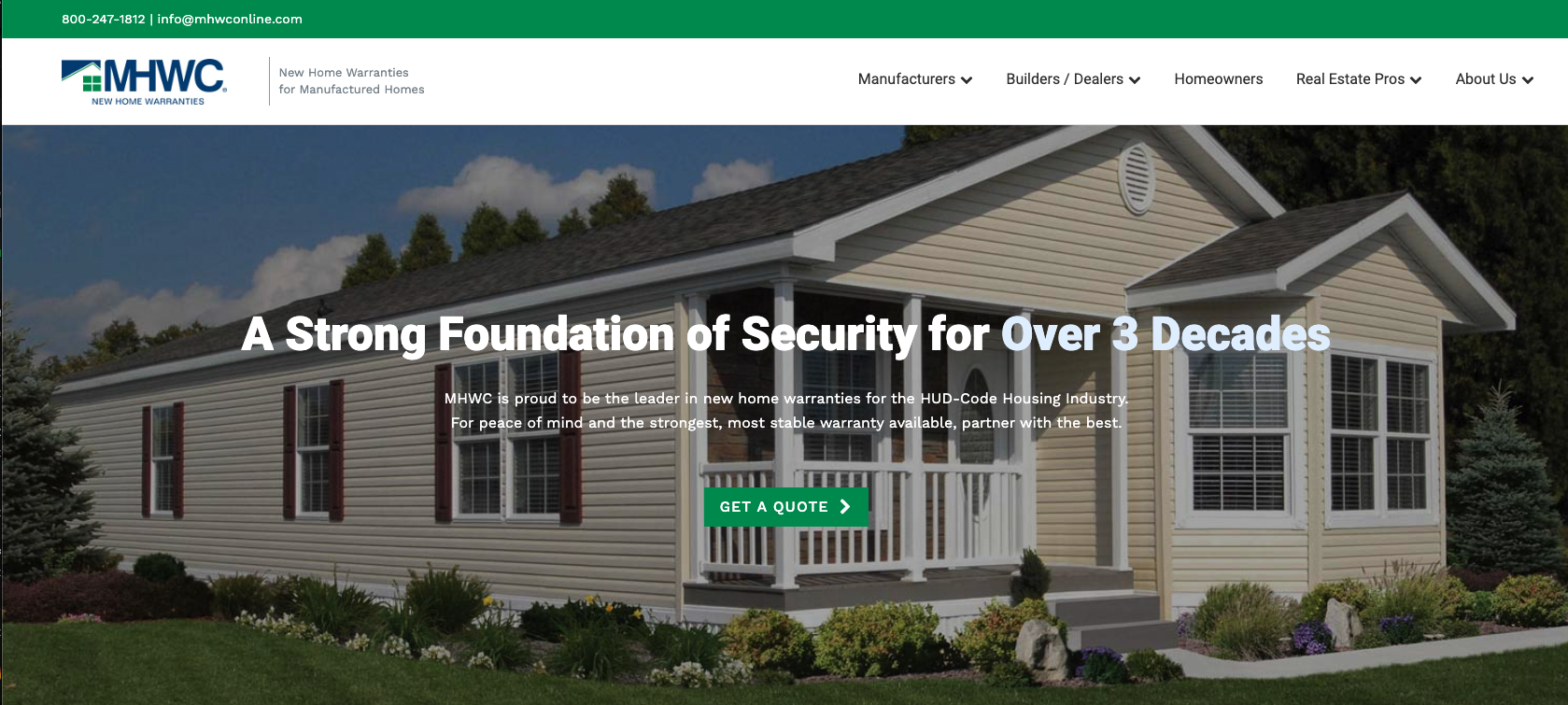
The streamlined menu is easy to navigate and the modern layout lends itself to a faster and better user experience. Have a look! Maybe you'll discover something new about the MHWC warranty. Our current and prospective members will find detailed info about our warranty products, instructions on how to become a member, resources for existing members, tradeshow schedules, FAQ, and can even contact us through one of the convenient online forms.
The RWC Member Services department has a new email address for members that need to return documents for approval or renewal:
membership@rwcwarranty.com

Feel free to use it if you have a question about what is needed for your new membership application or how to get your renewal finished. It’s quick and easy and your request will go to a team of advisors instead of just one individual for the fastest service possible. We are working harder on our end so you can focus on building homes on yours!
Hypothetical situation. Let's say you've been contracted to build a custom home by someone who was referred to you by a satisfied customer. This individual owns the land and is financing the project out of his own pocket. You are the general contractor with complete authority over the entire project. The single family home you're building is a typical design and requires nothing out of the ordinary. Construction proceeds without a hitch. Then, with the house about 80% complete, fire breaks out in the basement on a Sunday night. The fire department determines a homeless person had decided to camp out in the unsecured structure and started a small fire to keep warm. Of course, it quickly got out of control and now more than $200,000 in materials have literally gone up in smoke.
 Your customer thought you were responsible for buying Builders Risk coverage as the general contractor. You were sure they had agreed to purchase a policy as the owner of the project. The written contract makes the general contractor, you, responsible for "all insurance." So you lose that argument. As someone who knew what they were talking about once observed, insurance isn't important until you need it. In trying to figure out what went wrong, you conclude that you have had to finance most of your projects in the past. That meant getting a construction loan from a bank. They won't lend a dime without proof of builders risk. In this case, there was no loan officer to dot all the i's and cross all the t's. Life is in the details.
Thankfully, this is only a hypothetical situation. Few professional builders would make such a mistake...right? Don't take chances. The RWC Insurance Advantage offers Builders Risk coverage almost anywhere in the United States for virtually any size residential construction project through Zurich - number one in Builders Risk insurance.
For more info or to get a quick quote:
www.rwcinsuranceadvantage.com
866-454-2155
